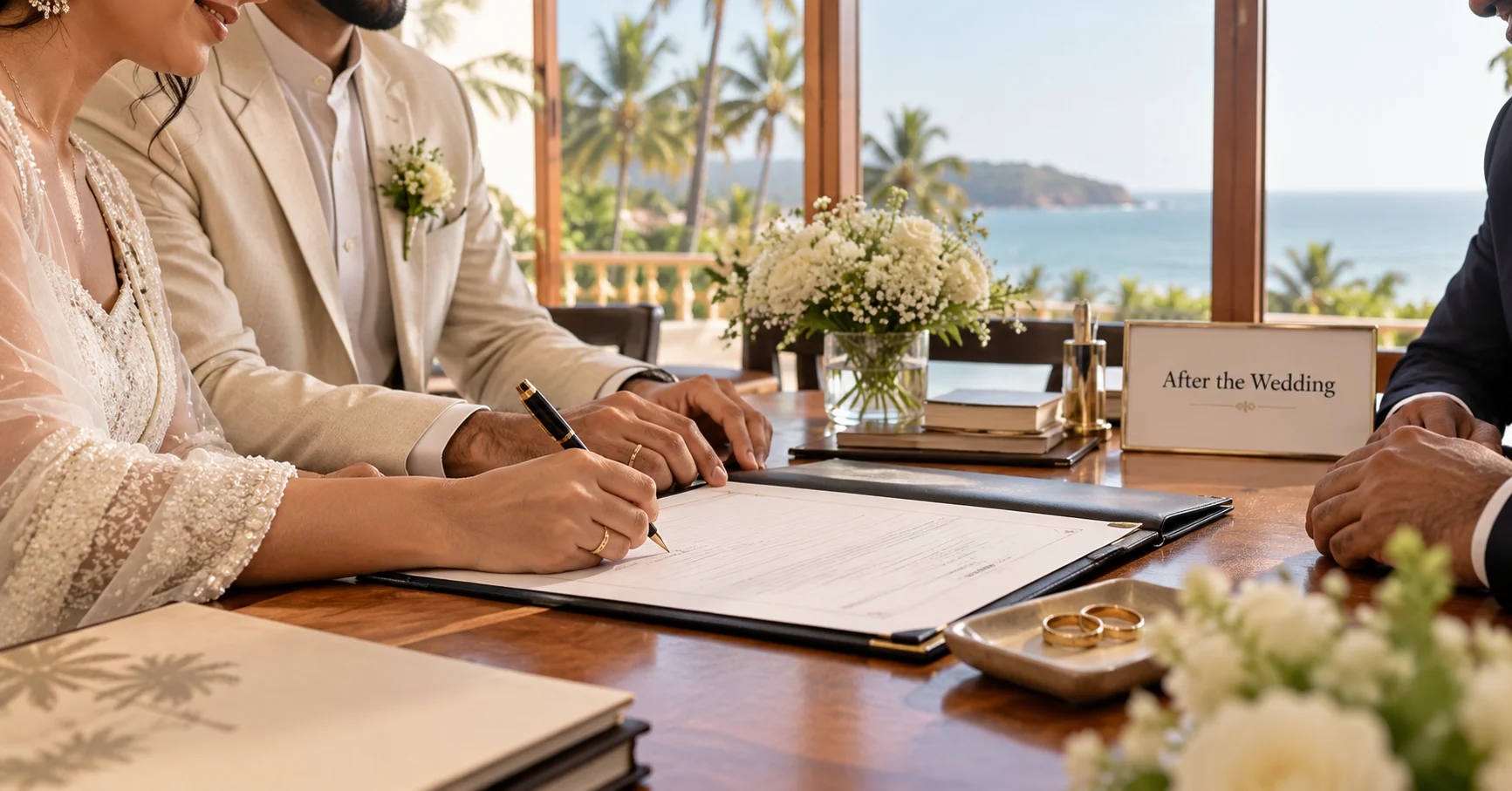

Goa is one of India's most popular destinations for weddings. The beach sunsets, luxury resorts, colonial charm, and laid-back atmosphere make it a dream setting for many couples. But before you book the venue or finalise the guest list, there is one critical thing you need to sort out: the legal side of getting married in Goa.
Here is the truth: most blogs skim over the legal details. They give you a vague list of documents and call it a day. This guide is different. Whether you are an Indian couple planning a destination wedding, an NRI tying the knot, or a foreign couple who fell in love with Goa's shores, this guide walks you through the core legal requirements, documents, process, timelines, and fees to verify.
While arranging the wedding celebration, remember to keep the legal paperwork and deadlines on a separate list so nothing is overlooked.

| Key Number | Meaning |
| 21 | Minimum age for groom under national law |
| 18 | Minimum age for bride under law, with Goa consent nuance if under 21 |
| 15 | Statutory waiting days after Stage |
| 11 | Civil Registrar-cum-Sub-Registrar offices listed by the Goa Marriage Portal |
Why Getting Married in Goa is Different From the Rest of India
Goa is not just geographically different from the rest of India. Its legal system for marriage is fundamentally different too, and for a very specific historical reason: Goa was under Portuguese rule for over 450 years (1510 to 1961). When India reclaimed Goa, the state retained its existing civil laws, which were rooted in Portuguese civil code and had been in place since 1867.
This means Goa operates under the Goa Civil Code, often referred to as the Common Civil Code of Goa. This is significant because it changes how marriages are registered, recognised, and governed in the state.

The Goa Civil Code: What Makes Goa Unique
The Goa Civil Code treats marriage as a civil contract between two persons. Article 1056 of the Goa Civil Code defines marriage as a formal legal agreement meant to legitimately constitute a family.
Here are the key features that make Goa's marriage law stand out:
| Feature | Rest of India | Goa |
| Governing law | Often religion-specific acts or civil law, depending on the route chosen | Goa Civil Code and Code of Civil Registration for marriages registered in Goa |
| Registration | Varies by state and law | Civil registration is required for legal recognition in Goa |
| Applies to | Varies by religion and legal route | Marriages registered in Goa, irrespective of religion |
| Marriage viewed as | Religious ceremony, civil act, or both | Civil contract recorded by the Civil Registrar |
| Church weddings | Usually require civil registration separately | Roman Catholic canonical marriages have a special provision with prior Civil Registrar clearance |
| Property rights | Often governed by personal law or the chosen civil law | Goa has a community property framework unless a valid antenuptial contract or exception applies. Get legal advice before registration. |
One important detail: In Goa, without civil registration, a marriage is not legally recognised. The only exception is a Roman Catholic canonical marriage performed in church, but even here the church coordinates with the Civil Registration office for formal recognition.
Basic Eligibility Requirements
Before you gather your documents, make sure both parties meet these basic eligibility conditions:
- Age: Under national law, the groom must be at least 21 years old and the bride must be at least 18 years old. Goa's official marriage guidance also states that the age of majority for marriage purposes is 21, and a bride between 18 and 21 may require parent consent or court emancipation.
- Single status: Both individuals must be legally single, divorced, or widowed at the time of registration. Bigamy is not permitted.
- Free consent: Both parties must give consent freely and willingly, without coercion.
- Sound mind: Both parties must be of sound mind and capable of giving valid consent.
- No prohibited relationships: Certain close-relative relationships are prohibited by law. Exceptions to the rule of consanguinity within 3 degrees of the collateral line require the Governor's permission.
- Prior marriage dissolved: If either person was previously married, they must present a divorce decree or death certificate of the former spouse.
Types of Marriages You Can Register in Goa
Goa recognises different legal and ceremonial routes. The route you choose affects the process, documents, and timeline.
1. Civil Marriage
A civil marriage is conducted directly through the Civil Registrar's office. It is a non-religious legal process and suits couples who want a straightforward civil union. For standard registration in Goa, the official process is linked to residence or domicile in the relevant Taluka.
The citizen charter refers to more than six months of continuous residence before filing the declaration. Couples coming from outside Goa should confirm eligibility with the Civil Registrar before planning travel.For a full step-by-step explanation, read this complete civil marriage in goa guide for Indian couples.
2. Canonical (Church) Marriage for Roman Catholics
Roman Catholic couples can have a canonical marriage in church. This has a special provision under Goa's civil registration system when prior clearance is taken from the Civil Registrar. The church and the Civil Registration office coordinate the formalities.
Couples should still personally verify that the papers have reached the Civil Registration office and collect the required certificate. The church process may include a pre-marriage course and submission of church-specific documents.
3. Hindu or Traditional Marriages
Hindu, Konkani, and other traditional ceremonies may be performed according to religious rites and customs. However, couples should complete civil registration at the Civil Registrar's office for legal recognition in Goa. The registration brings the marriage under the Code of Civil Registration.
4. Court Marriage Under the Special Marriage Act
The Special Marriage Act, 1954, may be relevant for some interfaith or secular marriages. However, Goa has its own civil registration framework, and couples should confirm with the Civil Registrar which route applies to their case.
Under the Special Marriage Act, a Notice of Intended Marriage is filed with the Marriage Officer, followed by a 30-day notice period before solemnisation and registration if there are no legal objections.
| Marriage Type | Governing Law | Waiting Period | Key Requirement |
| Civil Marriage | Goa Civil Code and Code of Civil Registration | The 15-day notice period applies in standard cases. | Residence or domicile requirement must be confirmed with Civil Registrar |
| Church (Canonical) | Goa Civil Code plus Canon Law | Varies by church and civil clearance process | Prior Civil Registrar clearance and church formalities |
| Hindu or Traditional | Religious ceremony plus civil registration in Goa | 15 days in standard civil registration cases | Civil registration for legal recognition in Goa |
| Special Marriage Act | Special Marriage Act, 1954, where applicable | 30-day notice period | Confirm applicability with Marriage Officer or Civil Registrar |
Documents Required for Marriage Registration in Goa
This is where most couples feel overwhelmed. Here is a clear, practical breakdown of what you may need.
Core Documents (for Both Parties)
- Birth Certificate of both parties. The birth certificates should clearly mention both parents' names. This is a common reason for delays, so verify it before you travel to Goa.
- Domicile or Residence Certificate showing continuous residence, issued by the Mamlatdar or Sarpanch of the Taluka or Village, or by the competent municipal authority. The official citizen charter refers to more than six months of continuous residence immediately before filing the declaration. Use a recent certificate and confirm the current validity window with the Registrar's office before filing.
- Passport-size photographs of both individuals.
- Valid government ID proof such as Aadhaar card, PAN card, Voter ID, or Passport.
- Registration fee payment.

Additional Documents for Special Situations
| Situation | Additional Document Required |
| Foreign national party | Court document (required by Civil Registrar) + NOC from embassy + passport |
| Residence outside Goa for over 1 year | Sworn oath (affidavit) |
| One party resides outside Goa | Affidavit confirming residential status |
| Bride is below 21 years | Written consent of parents, or court permission |
| Previously divorced | Divorce decree from court + applicable waiting period |
| Previously widowed | Death certificate of former spouse + waiting period |
| Consanguinity within 3 degrees (collateral line) | Governor's special permission |
| Physical inability to attend office | Marriage can be conducted outside office with additional witnesses and fees |
| Marriage by proxy | Special Power of Attorney |
| Ante-nuptial contracts | Copy of the relevant documents |
Legal requirements need careful attention, but your other wedding arrangements should also stay organised while you complete the necessary formalities.
Step-by-Step Marriage Registration Process in Goa
The Goa civil registration process is generally completed in two stages, with a mandatory waiting period in between.
Gather All Documents: Collect birth certificates, residence or domicile certificates, IDs, and any special documents that apply to your case. Ensure birth certificates clearly show both parents' names.
Identify the Correct Civil Registrar Office: Go to the Civil Registrar-cum-Sub-Registrar office of the Taluka where the residence requirement is satisfied. The Government of Goa's Marriage Portal notes eleven Civil Registrar-cum-Sub-Registrar offices, one in each Taluka, along with District Registrar offices for North Goa and South Goa.
Stage I: File the Declaration of Marriage:
Both parties appear in person at the Civil Registration office. If the bride is between 18 and 21 years, parent consent or court permission may be required. Submit the required documents, pay the fee, and the Civil Registrar records the declaration.
The Edital Period (Mandatory Waiting Period): After Stage I, a public notice is affixed at the Civil Registrar's office inviting any legal objections. The statutory waiting period is 15 days, including two Sundays. If the parties come from different Talukas, the notice process may involve both offices.
Waiving the Edital Period (If Needed): In deserving cases, a waiver of the waiting period may be requested from the Delegado, also referred to as the Assistant Public Prosecutor in the official guidance. This is not automatic. If approved, the second appointment may be scheduled sooner.
Stage II: Actual Registration of the Marriage:
After the edital period, or after a valid waiver, both parties and at least two witnesses appear at the Civil Registrar's office. The marriage is formally registered, the register is signed, and the marriage is officially recorded.
Receive the Marriage Certificate: After registration, you can receive the official marriage certificate. The Goa Marriage Portal states that digitally signed marriage certificates can be issued through the system after completion. Keep certified copies, as you may need them for name changes, passport updates, visa applications, and other legal work.
Online Registration (Optional): The Government of Goa allows couples to initiate marriage-related services online through the official Goa Marriage Portal at reg.goa.gov.in. Applicants can fill in details, upload documents, make online payments, and take appointments. Physical presence is still required for the registration stages.

Fees, Timeline, and Where to Register
Registration Fees
| Service / Fee Item | Current Guidance for 2026 |
| Basic marriage registration fee | The official Registration Department citizen charter lists a registration fee of Rs. 200. Confirm the live fee on the portal or at the office before filing. |
| Marriage certificate/extract/true copy | Fees may vary by type of copy and service route. Check the Registration Department fee chart or portal at the time of application. |
| Online services | The Goa Marriage Portal allows online payment and appointments. The payable fee is displayed during the application flow. |
| Special cases | Extra fees may apply for outside-office solemnisation, proxy matters, certified copies, translations, affidavits, or legal assistance. |
Typical Timeline
| Stage | Time Required |
| Document preparation and collection | 1 to 4 weeks or more, depending on residence proof, birth certificates, embassy documents, and special-case documents |
| Stage I: Filing Declaration | 1 appointment, after documents are accepted |
| Edital waiting period | 15 days, including two Sundays, unless a valid waiver is granted in a deserving case |
| Stage II: Final Registration | 1 appointment with both parties and required witnesses |
| Certificate issuance | May be issued after completion. The Goa Marriage Portal states that digitally signed certificates can be issued through the system. |
| Total planning window | Plan several weeks in advance. Do not leave registration to the final few days before the wedding. |
Where to Register
Goa's Registration Department operates 11 Civil Registrar-cum-Sub-Registrar offices, one in each Taluka. There are also two District Registrar offices in North Goa and South Goa. Visit reg.goa.gov.in for the full list of office locations and contact details.
NRIs and Foreigners Getting Married in Goa
Goa is popular among NRI couples and international couples for destination weddings. If either or both of you are foreign nationals, here is what you need to know. NRI couples should also read this destination wedding in Goa for NRI couples guide for travel, guest, and planning details.

For NRIs (Non-Resident Indians)
- If an NRI has resided outside India for more than one year, they must submit a sworn oath (affidavit) confirming their status.
- If one party resides outside Goa, an affidavit to this effect is required.
- NRIs may need additional affidavits, notarised documents, or consular documents depending on their residence and citizenship status. Check with the Civil Registrar's office for your specific case.
- Foreign-issued documents should be apostilled, consular-attested, notarised, or translated as required for your specific case.
NRI couples should also read this destination wedding in goa for NRI couples guide for travel, guest, and planning details.
For Foreign Nationals
- Birth certificates of both parties with both parents' names clearly mentioned.
- Individual affidavits from each party stating that there is no legal impediment to the marriage in Goa.
- Residence certificate in Goa. Foreign national cases may require a one-month residence certificate, but couples should confirm the exact requirement with the Civil Registrar before travel.
- Passport copies of both parties.
- No Objection Certificate (NOC) from their respective embassy or consulate in India.
- Court document or legal-status document as required by the Civil Registrar for foreign national cases.
- Four witnesses who personally know the parties and can confirm they are not previously married.
- All documents not in English must be translated and notarised.
Foreign couples planning Indian rituals can also read this guide on planning an indian wedding in goa as a foreigner.

Is a Beach Wedding in Goa Legally Valid?
This is one of the most frequently asked questions by couples planning a Goa wedding. The answer is nuanced.
A beach ceremony alone is not a legally recognised marriage in Goa. A destination wedding celebration on a beach, no matter how elaborate, is not a substitute for civil registration. It is a beautiful ceremony, but it has no legal standing without a corresponding registration at the Civil Registrar's office.
How Most Couples Handle This
Most couples choose one of these two approaches:
If you plan to register specifically in Goa, plan well in advance because of residence requirements, document checks, and the 15-day edital period. Do not assume that arriving a few days before the wedding will be enough.For ceremony setup, weather, and beach permissions, read these beach wedding planning tips.
Common Mistakes Couples Make (And How to Avoid Them)
After helping dozens of couples with their Goa weddings, these are the mistakes we see most often:
| Mistake | Why It's a Problem | How to Avoid It |
| Birth certificate without parents names | The Civil Registrar may reject or delay the application | Get a fresh birth certificate with parents names listed, or ask the office what supporting proof is acceptable |
| Arriving too close to the intended registration date | The waiting period, residence requirements, and document checks may prevent registration on time | Begin legal planning early and verify the process with the correct Taluka office |
| Invalid or outdated residence certificate | The Registrar may require recent residence proof | Get current documents shortly before filing and confirm validity with the office |
| No embassy or consular NOC for foreign nationals | Registration may not proceed without required foreign-national documents | Contact the embassy or consulate in India well in advance |
| Wrong Taluka office | Filing in the wrong jurisdiction causes delays | Register in the Taluka where the residence requirement is satisfied |
| Assuming the beach ceremony is legally valid | A ceremonial beach wedding alone does not create a legal marriage | Complete civil registration separately at the Registrar office or register at home first |
Your Complete Pre-Wedding Legal Checklist for Goa
The WedMyDay Pre-Wedding Legal Checklist
Use this checklist to make sure everything is in order before your big day in Goa.
3 to 6 Months Before
- Confirm both parties meet age and eligibility requirements.
- Decide which type of marriage registration suits you (civil, canonical, Special Marriage Act).
- If a foreign national, contact your embassy in India to begin the NOC process.
- Order birth certificates for both parties with parents' names clearly listed.
- If previously married, gather divorce decree or death certificate of former spouse.
- Apostille all foreign documents as required.
1 to 2 Months Before
- Confirm which Civil Registrar's office (Taluka) you will register with.
- Confirm the residence or domicile requirement for your case with the Civil Registrar.
- Begin applying for the domicile/residence certificate from the Mamlatdar.
- Identify and inform your witnesses. Stage II normally requires two witnesses; foreign national cases may require additional witnesses.
- Collect all passport-size photographs.
- If court marriage under Special Marriage Act: file Notice of Intended Marriage.
Within 30 Days of Registration
- Collect the current residence or domicile certificate as advised by the Civil Registrar.
- Book your Stage I appointment at the Civil Registrar's office.
- Submit all documents at Stage I and pay registration fees.
- Wait out the 15-day edital period, or apply to the Delegado or Assistant Public Prosecutor for a waiver if your case qualifies.
- Attend Stage II with the bride, groom, and 2 witnesses for final registration.
- Receive and keep multiple copies of the marriage certificate.

Final Thoughts: Plan Early, Marry Peacefully
Getting married in Goa is a dream for many couples across India and around the world. The beaches, warm weather, world-class resorts, and Portuguese heritage make it one of the most beautiful places to begin married life.
But the legal side of things is not something to leave to the last minute. The Goa Civil Code is structured and transparent, but it requires time, the right documents, and the right planning. The mandatory 15-day waiting period alone means you cannot complete the process in the final few days if you plan to register in Goa.
The good news is that once you understand the process, it is manageable. Gather your documents early, confirm the right Civil Registrar's office, follow the two-stage process, and keep enough time for the waiting period and document checks.
With proper planning, you can complete the registration process and enjoy your celebration with peace of mind.If your celebration includes a beach ceremony, check the separate beach wedding permission in goa process because event approval and legal marriage registration are different.