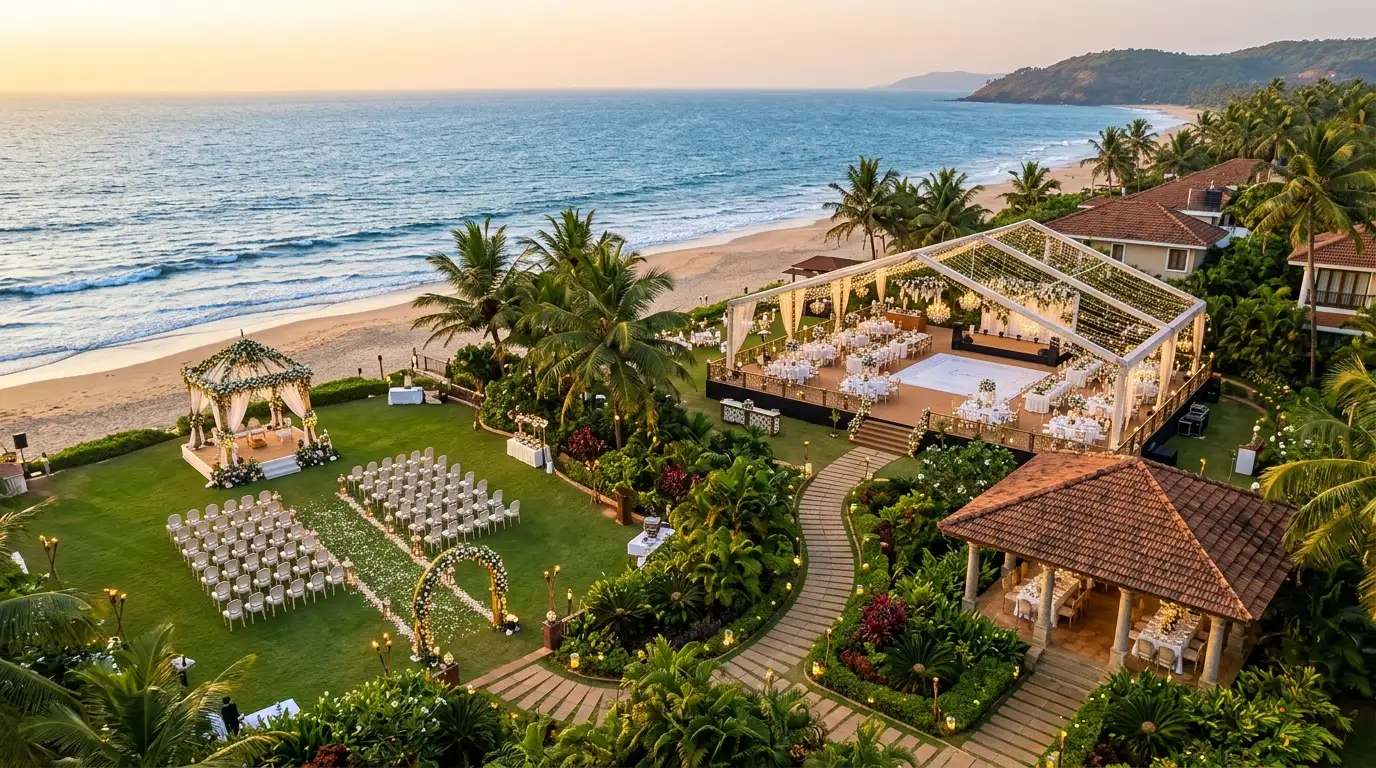
When planning a beach wedding, the most important things to get right are: booking 12 months in advance, sorting permits early, choosing the right season and time of day, having a weather backup plan, picking vendors with beach experience, wind-proofing your decor, planning for guest comfort in the heat, and scheduling photography around golden hour. This guide covers all 25 things in detail.
Key 2026 Planning Facts
| Topic | Updated 2026 Guidance |
| Planning stat | 1 in 4 Indian weddings are now destination celebrations, according to WedMeGood 2025 report coverage. Goa is listed among popular domestic locations. |
| Goa weather | Goa Tourism lists June to September as the monsoon season. October to March is generally more comfortable for outdoor weddings, with November to February as the strongest peak wedding window. |
| Sound permission | South Goa District guidance states loudspeaker permission is up to 10 PM and should be applied for at least 15 days before the event. |
| Beach permissions | Goa Tourism guidelines include beach weddings under tourism-related events outside licensed premises. Minor events should be applied for at least 15 days in advance, and major events much earlier. |
A beach wedding is one of the most visually spectacular ways to celebrate love. The ocean stretches out behind you, the breeze carries the scent of salt water, and the light at golden hour does things no photographer can replicate indoors. It is no surprise that beach weddings are consistently the most popular choice for destination wedding couples across India and around the world.
But a beach wedding also comes with a very specific set of logistics that an indoor ballroom wedding will never throw at you. Tides, wind, permits, heat, sand, outdoor acoustics, and guest comfort in the sun all demand thoughtful planning decisions. The couples who love their beach weddings are the ones who planned for these realities. The ones who do not always end up overwhelmed on the day.
This guide covers all 25 things you need to know before you plan a beach wedding, from the very first decision you will make to the final detail on the day itself.
Tip 01: Start Planning Much Earlier Than You Think You Need To
Planning Timeline
The number one mistake couples make with beach weddings is starting too late. A beach wedding involves far more moving parts than a standard indoor venue wedding. Permits take time. Beach resorts book out. The best photographers, decorators, and caterers with beach experience get snapped up fast.
For a destination beach wedding in a popular location like Goa, you should start the planning process at least 12 months in advance. For peak-season dates in Goa (November through February), the top beach resorts and vendors book out 12 to 18 months ahead. For a complete month-by-month planning flow, follow this destination wedding checklist for goa.If you want a specific date at a specific property, you need to secure it long before anything else.
Even if your wedding is local and smaller, give yourself six to eight months minimum. Permits, approvals, vendor bookings, and guest travel arrangements all need runway.
Timeline milestones
- 12 to 18 months out: Set the date, shortlist and book the venue
- 10 to 12 months out: Book photographer, caterer, and key vendors
- 8 to 10 months out: Send save-the-dates, begin permit applications
- 4 to 6 months out: Confirm all vendors, finalise decor plan
- 1 to 2 months out: Confirm permits, do a full site visit and rehearsal
Tip 02: Choose the Right Season and Time of Day
Season & Timing
Not all times of year are created equal for a beach wedding. The best season depends on your location, but the general principle is universal: you want dry weather, manageable heat, and calm winds.
For beach weddings in Goa, Late October to March is generally the most comfortable outdoor window for a Goa beach wedding, with November to February as the strongest peak wedding season. The monsoon usually runs from June to September, so outdoor beach ceremonies need a strong indoor or covered backup during those months. April and May are hotter and more humid, so they work better for shorter ceremonies, shaded setups, and indoor receptions.Your beach setup will work best when you choose the right month for a goa wedding.
Time of day matters just as much as the season. Avoid a midday ceremony. The sun is directly overhead, guests squint into the light, the heat is at its peak, and your photographs will have harsh shadows. The two ideal windows are early morning (7 to 9 AM) for a soft, cool ceremony, and late afternoon or evening (4 to 6 PM) for a sunset ceremony that gives you stunning golden-hour photography right after the vows.
Tip 03: Understand Resort-Managed Beachfronts vs Open Public Beaches
Venue Choice
This is one of the most important early decisions you will make, and it affects almost everything else: permits, privacy, logistics, and budget.
| Factor | Resort-Managed Beachfront | Open Public Beach |
| Privacy | Higher privacy. Ask the venue what is genuinely exclusive to your event | Low. Other people may be present |
| Permits | Resort often coordinates many permissions, but confirm the exact scope in writing | You or your planner must coordinate permissions with the relevant authorities |
| Amenities | Restrooms, power, catering, parking included | All amenities must be arranged separately |
| Cleanup | Managed by venue staff | Your responsibility entirely |
| Cost | Higher venue fee but lower logistics cost | Lower access cost but higher logistics cost |
| Reliability | Maintained, predictable surface | Variable conditions on the day |
For most couples planning a beach wedding in India, a resort-managed beachfront venue is usually the easier and more elegant choice. The venue can coordinate power, catering infrastructure, restrooms, and many operational details. Still, always confirm which permissions the venue handles and which approvals remain your responsibility.
For a Goa-specific approval path, read this beach wedding permission guide before choosing between resort-managed beachfront and open public sand.
Tip 04: Sort Out Permits as Early as Possible
Permits & Legalities
Permits are the most overlooked part of beach wedding planning, and ignoring them can derail your entire event. For a beach wedding in Goa, beachside events held on public beaches or outside licensed premises may require permission through the Department of Tourism or the applicable single-window process. Depending on the setup, you may also need coastal-zone, local authority, landowner, police, sound, fire, fireworks, and traffic-related approvals. For beach sound permission in South Goa, official guidance specifically asks for NOCs from the coastal authority and Tourism Department.
Even at private resort venues, additional approvals may be needed for specific activities. Beach ceremonies may also involve documentation, so review the goa wedding legal requirements early.The most common rules to know about in Goa are:
- Outdoor loudspeaker permission is generally issued only up to 10 PM unless there is a specific written permission or approved venue arrangement
- Fireworks and pyrotechnics require specific prior approvals
- Some beach zones have restrictions on the structures you can erect
- Environmental regulations apply to decorations on or near the waterline
Tip 05: Always Have a Solid Backup Plan for Bad Weather
Weather
Every beach wedding planner will tell you this is non-negotiable. Weather is unpredictable, especially near the coast. Even in Goa's best season, an unexpected pre-monsoon shower or a sudden strong wind can disrupt an outdoor ceremony. You need a Plan B that is fully prepared, not just vaguely considered.
A good weather backup plan means identifying a covered or indoor space at or near your venue that can host the ceremony at very short notice. It means your decorators know how to quickly shift the setup. It means your guests know what to do if the ceremony moves.
The best beach resort venues have an indoor or covered backup space that mirrors the aesthetic of the outdoor setting. When you tour potential venues, always ask: "Where exactly will we move to if the weather does not cooperate?" If the answer is vague, that is a red flag.
Tip 06: Check the Tide Schedule Before You Finalise Your Ceremony Time
Logistics
This is something a surprising number of couples forget entirely. Tides change the width of the beach, the position of the waterline, and the accessibility of your ceremony space. High tide at the wrong time can reduce your beach space dramatically, or push water close to where your guests are seated.
Before finalising the ceremony time, look up the tide chart for your specific beach on your wedding date. Tidal schedules for any date and location are freely available online. You want to time your ceremony for low to mid tide so you have the maximum usable beach space and a safe distance from the water.
For Indian beach venues, your resort or wedding planner should be able to advise on this. A planner with local beach experience will automatically factor tidal patterns into your day's schedule.
Tip 07: Hire Vendors Who Have Real Beach Wedding Experience
Vendors
A florist who has never worked in salt air does not know which flowers will wilt in two hours under coastal sun. A sound technician who has never set up audio on a beach does not know how the wind will scatter sound. A caterer who has not served a beach reception does not know how quickly food spoils in coastal heat.
Beach weddings punish inexperience in ways that indoor weddings simply do not. When you interview vendors, always ask these specific questions:
- How many beach or outdoor coastal weddings have you worked on?
- How do you handle wind for your setups or arrangements?
- What changes do you make to your approach for beach conditions?
- Can you show me photos or references from beach weddings specifically?
If your preferred photographer or makeup artist is not based locally, factor in their travel and accommodation costs. Flying in a Delhi-based vendor to Goa adds to the budget but can be absolutely worth it for the right person. Just ensure they have done outdoor coastal work before. If you are managing permits, vendors, and weather backup remotely, this guide explains why hiring a wedding planner in goa can help
Tip 08: Know the Sound Rules and Plan Your Music Accordingly
Music & Sound
Sound at a beach wedding is regulated differently from indoor events. In Goa, loud outdoor music must typically wrap up by 10 PM under most venue licenses. Some venues have extended licenses, and some suggest alternative options like silent disco or after-party setups with headphones for guests who want to continue dancing.
Always confirm the specific sound deadline for your venue in writing before booking. Design your evening schedule around this limit so your reception and dinner program fit comfortably within the permitted window.
Many couples working with venues that have strict noise limits plan the energetic dancing portion of the reception early in the evening, then transition to a quieter acoustic set or ambient music as the deadline approaches. This keeps the energy high while staying compliant.
Tip 09: Design Your Decor to Handle Wind, the Beach Is Always Breezy
Decor
Wind is the most predictable challenge at a beach wedding and yet the one most often unplanned for. A Goa beach in the afternoon almost always has a coastal breeze. Lightweight paper flowers blow away. Tall, thin floral arrangements tip over. Chiffon table runners become a tangle. Menu cards and escort cards scatter.
Wind-proof beach decor is a skill your decorator needs to have. Here is what works and what does not:
| Decor Element | Wind-Friendly Choice | Avoid |
| Aisle markers | Lanterns with candles in glass, weighted bamboo posts | Tall floral stakes, paper pom-poms |
| Table centrepieces | Low glass bowls with flowers and water, weighted bases | Tall vase arrangements, lightweight fabric |
| Signage | Weighted boards, framed signs with stands secured in sand | Paper banners, lightweight easels |
| Bouquets | Compact, tightly bound, seashell or dried floral styles | Loose, flowing, tall arrangements |
| Table runners | Woven or rope runners, weighted with decor elements | Chiffon or lightweight fabric |
| Ceremony arch | Bamboo or driftwood with secured greenery and blooms | Balloon arches, paper florals |
The general rule is: keep it low, weighted, and secured. Less is genuinely more at a beach wedding. The ocean and the sky are doing most of the decorating for you.
Tip 10: Choose Flowers That Can Survive Heat and Salt Air
Florals
Not all flowers behave well in coastal heat and humidity. Delicate roses, tulips, and lilies can wilt within an hour in strong sun. You need flowers that are robust enough to last the ceremony and look fresh in your photos hours later.
Flowers and foliage that work beautifully in coastal conditions include:
- Bird of paradise, dramatic, structured, and extremely resilient
- Orchids, hold up exceptionally well in heat and humidity
- Protea, bold, architectural, and very tough
- Plumeria (frangipani), the quintessential tropical bloom, perfect for Goa
- Tropical foliage, palm leaves, monstera, banana leaf, sculptural and heat-proof
- Pampas grass, works very well as a textural element and holds up in wind
- Dried florals and seashell arrangements, no wilting risk at all
Ask your florist to keep floral arrangements in a cool, shaded space until the last possible moment before setup. For centrepieces that will be in full sun, choose foliage-heavy arrangements over bloom-heavy ones.
Tip 11: Seat Your Guests Facing Away From the Sun
Ceremony Setup
This one seems obvious but is frequently overlooked during venue walkthroughs. If your guests are seated facing into direct afternoon sun, they will spend your ceremony squinting and uncomfortable. They will not be able to see your faces clearly, and every photo of the guests will show rows of people shielding their eyes.
The ideal setup depends on the beach, date, and time of day. Visit the site at the same time as your planned ceremony and place the seating so guests are not looking directly into the sun. Your altar should give the couple a beautiful backdrop without forcing guests to squint through the ceremony.
Visit your venue site at the same time of day as your planned ceremony. Look at where the sun is positioned. Walk the space as if you are placing chairs. This one visit can prevent a significant guest experience problem on the day.
Tip 12: Make Guest Comfort in the Heat Your Top Priority
Guest Comfort
A beach wedding in Goa asks a lot of your guests. They are outdoors in tropical heat, likely dressed in formal ethnic wear, possibly sitting through a multi-hour ceremony. If you do not plan for their physical comfort, the most beautiful setting in the world will not save the experience.
Here is what great beach wedding hospitality looks like:
- Shade structures, canopies, parasols, or a covered mandap for guests seated during the ceremony
- Welcome station, chilled water, nimbu pani, and coconut water at the entrance as guests arrive
- Hand fans, printed with your wedding monogram as both comfort and a keepsake souvenir
- Chilled towels, small rolled towels in an ice bucket for daytime events are a simple but much-appreciated gesture
- Sunscreen station, small bottles of SPF at the entrance for afternoon ceremonies
- Clear footwear guidance, let guests know in advance that the ceremony is on sand so they can dress accordingly
For evening receptions, the comfort concern shifts from heat to insects. Citronella candles, mosquito-repellent coils placed discreetly around the perimeter, and repellent wristbands at the welcome table are all thoughtful touches.
Tip 13: Plan Your Sound and Microphone Setup With the Beach in Mind
Audio
Sound behaves very differently outdoors near the ocean. Wind carries sound away from the audience. Waves create a constant background noise that competes with voices and music. Standard indoor audio setups simply do not work well on a beach.
You need a sound technician who understands outdoor coastal acoustics. Specifically:
- Use directional speaker placements that face the audience, not just a single central speaker
- Both the couple and the officiant should have wireless lapel microphones. Handheld microphones in a sea breeze are unreliable
- Test the complete audio setup on the actual beach at a similar time of day before the wedding
- Have a backup audio source in case a microphone fails
- The DJ or live musicians should have a wind shield on all microphones
Tip 14: Get Your Evening Lighting Right, It Makes or Breaks the Reception
Lighting
Once the sun goes down at a beach wedding, you are entirely dependent on your artificial lighting. The right lighting transforms a beach reception into something magical. The wrong lighting leaves guests in the dark and ruins every photo after sunset.
Lighting elements that work beautifully for beach receptions include:
- String lights canopied over the reception area, warm, romantic, and iconic for beach settings
- Hurricane lanterns lining the aisle, weighted glass lanterns stay put in the wind
- Tiki torches marking the perimeter, create atmosphere and gentle boundary definition
- Uplighting on the ceremony arch, keeps the focal point visible and dramatic after sunset
- Fairy lights woven into table centrepieces, soft, warm, and highly photogenic
Work with your decorator and photographer together when planning lighting. Your photographer will tell you exactly what kind of ambient light they need to capture beautiful images after dark. This collaboration prevents the common problem of decor lighting that looks lovely in person but produces dark, flat photographs.
Tip 15: Dress for the Beach, Not the Banquet Hall
Attire
This applies to both the couple and their guests. The fabrics and silhouettes that look stunning at a palace wedding in Rajasthan will make you uncomfortable and over-heated at a Goa beach ceremony. The beach demands a completely different wardrobe approach.
For the couple: choose lightweight, breathable fabrics. Chiffon, georgette, linen, light silk blends, and organza all work beautifully outdoors. For brides, a lighter lehenga or a flowy gown will feel manageable through a long ceremony. For grooms, a linen bandhgala, a linen kurta set, or a linen suit are all far more appropriate than a heavy sherwani.
For guests: let them know ahead of time that the event is outdoors on sand. Many guests will arrive in heavy silk sarees or brocade sherwanis because they did not realise the setting. A simple note in your invitation or on your wedding website with outfit guidance is a genuine kindness.
Colours that work beautifully against the beach setting include pastels, corals, aquas, turquoise, ivory, and tropical prints. Strong, dark colours absorb heat and can look heavy against the bright outdoor light.
Tip 16: Choose the Right Footwear, Stilettos and Sand Do Not Mix
Footwear
This is one of the most practical pieces of advice in this entire guide. Stiletto heels sink into sand with every step. Walking the aisle in heels on a beach is genuinely difficult. Dancing in them at a beach reception is exhausting and hard on your feet. And after a full day of a beach wedding, your feet will be sore enough without adding the challenge of narrow heels in soft ground.
What works well for women: embellished flat sandals, block heels, wedges (the heel distributes weight over a larger surface and does not sink), jewelled kolhapuri chappals, or juttis. If you want to be barefoot for the ceremony, that is a beautiful choice at a beach wedding, just make sure you have something to change into for the reception.
What works well for men: loafers in canvas, suede, or leather, moccasins, mojaris, or clean leather sandals. Skip the socks entirely. Nothing looks more out of place at a beach wedding than socks with sandals or loafers.
Tip 17: Build Your Photography Schedule Around Golden Hour
Photography
Golden hour, the 30 to 60 minutes after sunrise and before sunset, is the most extraordinary time to be photographed at a beach. The light is warm, directional, soft, and flattering. It bounces off the water and creates natural photography conditions that no studio flash can replicate. Every couple photograph looks stunning in golden hour light.
The single most powerful thing you can do for your beach wedding photography is structure your day so that the couple portraits happen during golden hour. Time your ceremony to finish roughly 45 minutes before sunset. This gives you the ceremony, then an immediate window for couple portraits in magical light, followed by the reception at dusk.
Discuss this specifically with your photographer. Ask them to review the exact sunset time for your wedding date at your venue location and help you work backward to set the ceremony start time. A great beach wedding photographer will already know this, but confirming it together ensures you are both aligned.
Also ensure your photographer has experience shooting in coastal light and knows how to handle the challenges of bright sand, reflective water, and harsh midday sun. Ask to see their portfolio from beach weddings specifically.
Tip 18: Protect Your Wedding Cake and Food From the Heat
Catering
Food safety and presentation are both affected by beach heat in ways that indoor catering is not. Buttercream cakes melt in direct sun. Dairy-based dishes spoil faster in coastal humidity. Ice cream dessert stations are nearly impossible outdoors in Goa's warmth. If this is not planned for, food quality and presentation can suffer significantly.
How to handle food and catering at a beach wedding:
- Keep the wedding cake out of direct sunlight and in a shaded or cooled area until it is time to cut it
- Choose fondant-covered cakes over buttercream for outdoor summer weddings, as fondant holds its shape much better in heat
- Work with a caterer who has beach wedding experience and knows how to manage food safety in outdoor conditions
- Opt for food stations over long buffet lines to ensure food is fresh and replenished regularly
- Choose a menu that includes dishes that hold well at ambient temperatures, not just hot or cold dishes that require equipment
- Ensure adequate refrigerated storage is available on-site for perishable items
For desserts specifically, consider individual or mini dessert options that can be brought out and served quickly rather than sitting on display in the heat for long periods.
Tip 19: Think Carefully About Guest Accessibility on Sand
Guest Accessibility
Sand is uneven, unstable, and genuinely challenging for some guests. Elderly family members, guests with mobility challenges, and very young children can all struggle on a sandy surface. This is a planning detail that is easy to overlook when you are imagining a beautiful barefoot ceremony, but it can cause real difficulties on the day.
Things to plan for:
- Identify which guests will have mobility challenges and seat them closest to a firm surface or pathway
- Consider using a boardwalk or fabric aisle runner that gives a stable walking surface to the ceremony area
- Ensure the venue has accessible pathways from the parking area and accommodation to the beach
- Have chairs with armrests available for elderly guests who may need support sitting and standing
- For guests using wheelchairs, check specifically whether the beach surface is accessible at all, and whether an alternative viewing position can be arranged
A resort beach with compacted firm sand is easier for most guests than a very soft, deep sandy public beach. This is one practical reason why resort beach venues are often preferred over open public beaches.
Tip 20: Build a Realistic Budget That Accounts for Beach-Specific Costs
Budget
A beach wedding is not automatically cheaper than a hotel ballroom wedding. In many cases it is more expensive, because you are building an event space from scratch in a location that has none of an indoor venue's built-in infrastructure. Power, restrooms, furniture, shade structures, sound equipment, and catering equipment all need to be brought in.
In Goa, a beach wedding can cost anywhere from Rs. 20 lakhs for an intimate gathering to Rs. 1 crore or more for a large-scale luxury celebration, depending on the venue, guest count, decor, and vendor choices.
Beach-specific costs that many couples underestimate include:
- Generator or power supply rental for outdoor events with no venue power
- Shade structures and tent hire for guest comfort
- Sound and AV equipment scaled for outdoor acoustics
- Permit fees for beach use, music, fireworks, and lighting
- Transport of vendors, decor, and equipment to the beach
- Cleanup and waste management after the event
- Outstation vendor travel and accommodation (photographers, makeup artists, etc.)
Tip 21: Communicate Clearly With Your Guests About What to Expect
Guest Communication
Guests who arrive at a beach wedding unprepared have a much worse time than guests who knew exactly what to expect. A beach wedding requires different clothing, footwear, and preparation than a standard indoor event. Your guests deserve this information in advance.
Include the following in your invitations, on your wedding website, or in a pre-wedding information card:
- The ceremony will be held outdoors on the beach, dress accordingly
- The surface is sand, advise against stilettos and suggest sandals or flat footwear
- Light, breathable fabrics are recommended for daytime events
- Sunscreen, sunglasses, and a hat are advisable for afternoon ceremonies
- Where they are staying and how to get from accommodation to the venue
- Whether there is a backup indoor option in case of bad weather
Out-of-town guests especially appreciate a travel guide covering accommodation options, transport from the airport, local tips, and the multi-day schedule. This kind of communication makes guests feel taken care of and significantly reduces the number of panicked calls you receive in the week before the wedding.
Tip 22: Plan Your Aisle Layout and Surface Thoughtfully
Ceremony Design
Walking an aisle on soft sand in a heavy lehenga or a fitted gown takes effort and concentration. The bridal walk is one of the most photographed moments of the entire wedding. You want the bride and anyone walking with her to feel confident and comfortable, not focused on not tripping.
Consider using an aisle runner, a length of fabric, a path of thick flower petals, or bamboo planks laid flat on the sand. This creates a defined, stable surface and gives the aisle a clear visual definition in photographs. Flower petals in a contrasting colour look stunning against white sand and are one of the simplest and most effective beach wedding aisle ideas.
Use rope strung between posts or simple lanterns placed in the sand to define the sides of the aisle. This gives guests a clear sense of where to stand or sit and creates a beautiful frame for photographs without requiring complex structures.
Tip 23: Do a Proper Rehearsal on the Actual Beach
Preparation
A rehearsal at a beach wedding is more important than at an indoor ceremony. You are asking people to navigate sand, position themselves around an outdoor altar, hear instructions over ambient noise, and carry out a ceremony in a non-standard environment. Everyone involved in the ceremony needs to have walked through it at least once before the day.
Hold the rehearsal on the actual beach, at a similar time of day as your wedding ceremony if possible. This lets you check the sun angle, the wind level, the sound carrying, and the aisle approach in realistic conditions. Identify any issues during the rehearsal when there is still time to fix them.
Include in your rehearsal: the bridal party entry and positioning, the officiant's position and projection level, the couple's seating/standing position, the ring exchange, and the exit. Also walk the path from the preparation area to the beach entrance so everyone knows the route.
Tip 24: Keep Your Ceremony at the Right Length for Outdoor Conditions
Ceremony Length
An outdoor beach ceremony in the heat requires a different approach to length than an air-conditioned indoor ceremony. Guests seated in the sun or the coastal breeze for a very long ceremony will begin to feel uncomfortable. Children will become restless. The energy of the event starts to drain.
A beach wedding ceremony between 20 and 40 minutes is generally ideal. This is enough time for all the meaningful ritual, readings, and vows without pushing guests to the limits of their comfort. If your ceremony is traditionally longer, speak with your officiant about which elements are essential and which can be abbreviated for an outdoor setting.
For Hindu ceremonies with multiple ritual elements, speak to your pandit about structuring the pheras and key rituals first, so the most meaningful and photographed moments happen while guests are still fully engaged and comfortable.
Tip 25: Leave the Beach Better Than You Found It
Responsibility
A beach wedding comes with a responsibility to the environment that an indoor event does not. The beach is a natural space, often an ecologically sensitive one. How you leave it after your celebration reflects on you and on the concept of beach weddings as a whole.
Before your wedding day, confirm clearly with all vendors who is responsible for cleanup and removal of every element they bring. At a resort venue, the venue typically manages overall cleanup. At a public beach, you must arrange it yourself, including post-event litter collection.
Make sustainable choices wherever possible:
- Avoid plastic decorations, balloons, and single-use plastic tableware
- Use biodegradable flower petals instead of paper confetti
- Ensure all lighting, fabric, and furniture is removed completely after the event
- Choose natural wax candles over synthetic options
- Brief your vendors that nothing is to be left on the beach or in the water
A beautiful beach wedding that leaves no trace is the finest compliment you can pay to the location that made your celebration so magical.
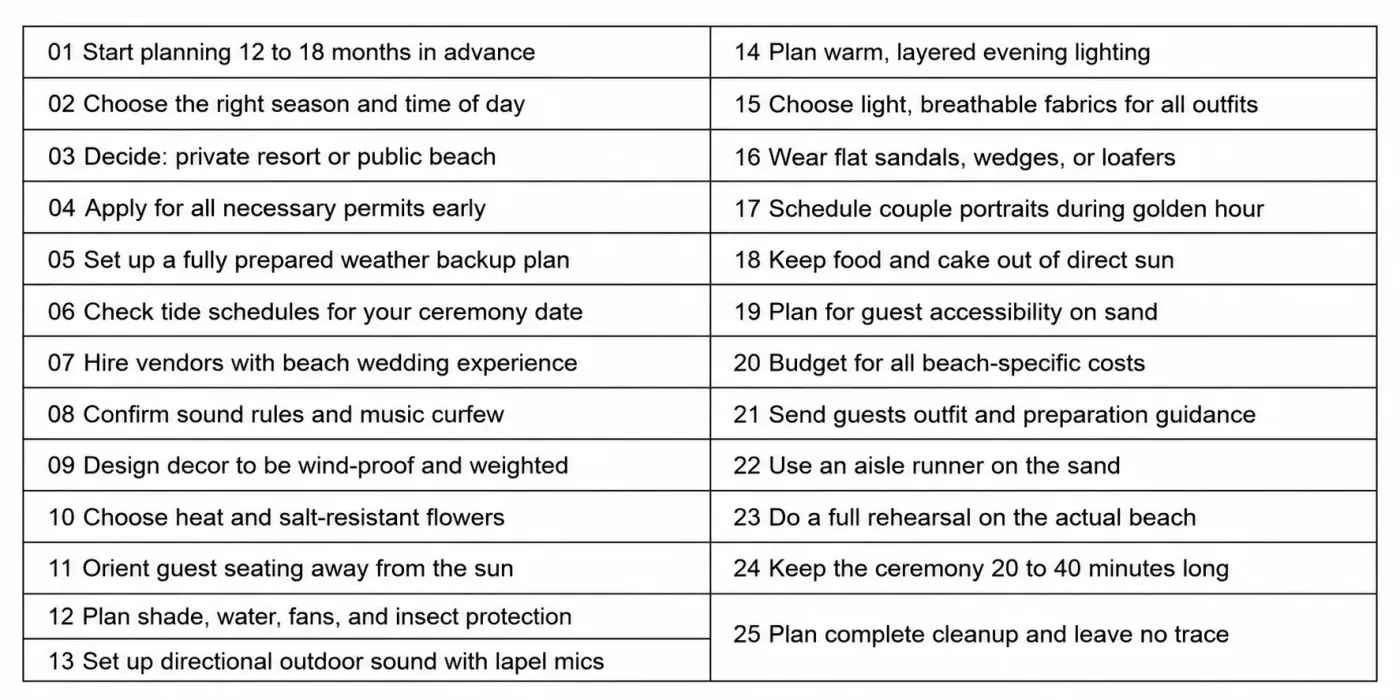
The Complete Beach Wedding Planning Checklist
All 25 things in a single at-a-glance as given below:
The Bottom Line
A beach wedding done well is one of the most romantic, visually spectacular, and personally meaningful ways to get married. The ocean provides a backdrop that no florist or decorator can replicate, and the feeling of celebrating surrounded by sea and sky is genuinely unlike anything else.
But it takes real planning to get there. The couples who have the most joyful beach weddings are the ones who took the logistics seriously in advance, so they could be completely present and relaxed on the day itself.
Use this guide and the complete checklist above as your planning foundation. Hire vendors who know beaches. Book early. Sort your permits. Wind-proof your decor. Keep your guests comfortable. Schedule your portraits at golden hour. And then let the ocean do its thing.
If you are planning a beach wedding in Goa, WedMyDay works with the finest beach resort venues and most experienced local vendors to make the whole process genuinely smooth. Explore our Goa destination wedding guide to get started.