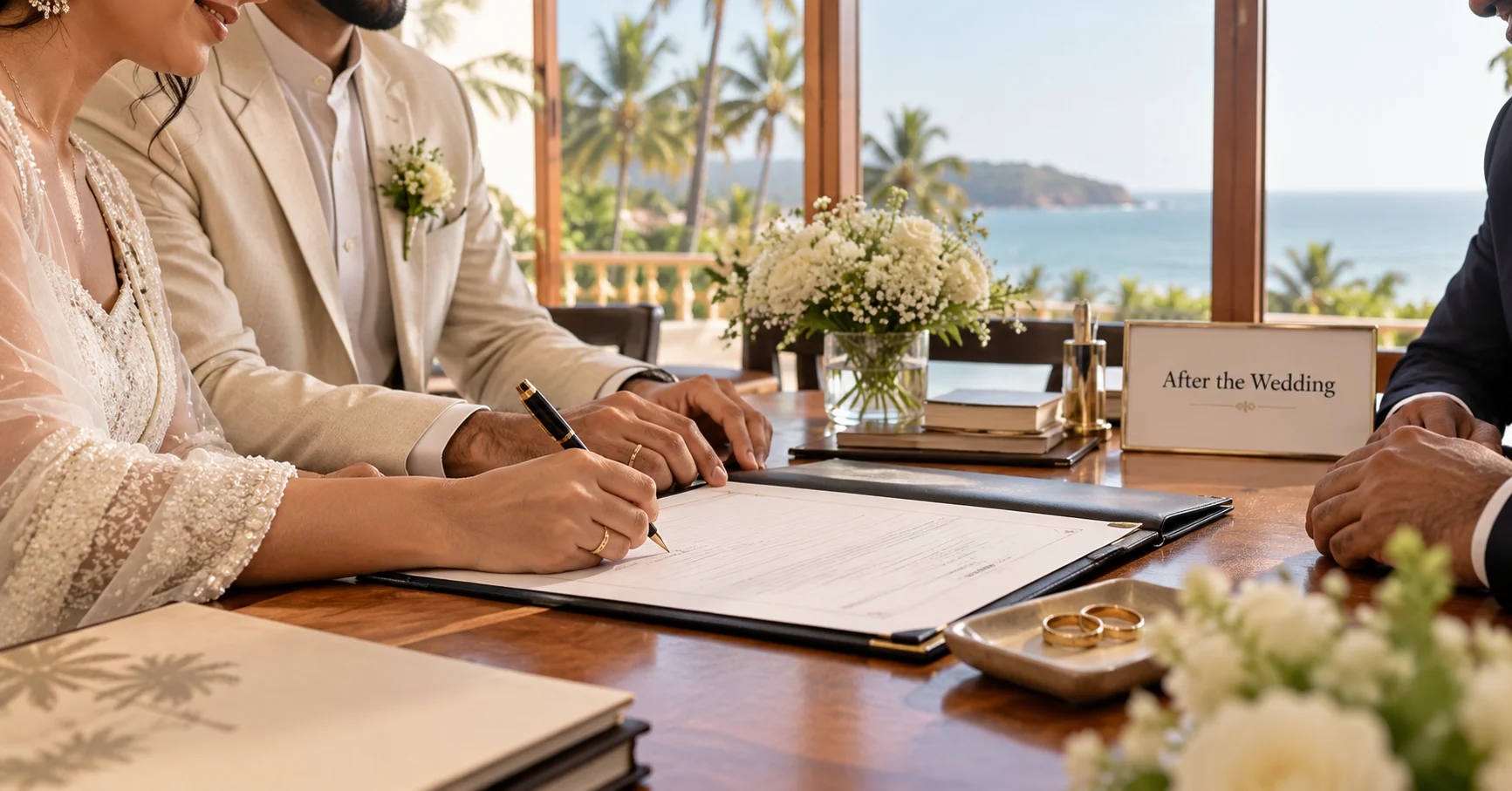
If you are planning to get married in Goa, or you already live there and want to make your marriage legally valid, you need to understand the civil registration process first. You should also understand the broader legal requirements for getting married in goa before filing documents.
Goa has its own marriage registration system. Skipping the right steps can leave you with a wedding that looks beautiful in photos but creates legal problems later.
This guide explains civil marriage in Goa in simple language. It covers who can marry, what documents you need, how the two-stage process works, how long it takes, what special cases to plan for, and the mistakes that delay most couples.
What Civil Marriage in Goa Actually Means
A civil marriage is a marriage that is registered with the government through a formal legal process. In Goa, this registration is not just a later proof of marriage. It is central to legal recognition.
The official citizen charter of the Goa Registration Department states that without registration, a marriage is not legally recognized in Goa. The main exception is a Roman Catholic marriage with prior clearance by the Civil Registrar, where the church process and civil record are connected.
Why Goa’s Marriage Law Is Different From Most of India
Goa has a distinct civil law history because it was under Portuguese rule until 1961. Its civil registration system developed from the Portuguese legal framework and continued after Goa became part of India.
Marriages in Goa are registered under the Code of Civil Registration, irrespective of religion. This means the civil registration process applies to couples across communities. A Hindu, Christian, Muslim, interfaith, or inter-caste couple can use the same civil registration route, subject to the specific requirements that apply to their case.
It is common to describe Goa as having a form of uniform civil code, but couples should understand this carefully. The civil registration process applies across religions, yet certain special provisions still exist, such as the Canonical Marriage process for Roman Catholics and separate legal rules around property and family matters.
If you plan to settle in Goa, buy property, or need advice on inheritance or marital property, speak with a local lawyer. Goa’s property and succession rules can differ from what couples expect in other Indian states.
Who Is Eligible to Register a Civil Marriage in Goa
Before filing the declaration, both partners must meet basic conditions.
- Age: The groom must be at least 21 years old. The bride must be at least 18 years old. Under Goa’s civil registration guidance, a bride between 18 and 21 needs consent from parents or a court emancipation order.
- Marital status: Both partners must be legally free to marry. They should be unmarried, legally divorced, or widowed.
- Consent: Both partners must consent freely, without pressure, force, or fraud.
- Mental capacity: Both partners must be capable of understanding the nature of the marriage contract.
- Relationship restriction: The couple should not fall within prohibited close relationship categories. A marriage within the third degree in the collateral line needs special permission from the Governor of Goa.
- Residence: The normal process requires a domicile or residence certificate showing continuous residence for more than six months immediately before filing the declaration. If one partner lives outside Goa, the Registrar may ask for additional affidavits or documents.
Documents Required for Civil Marriage Registration in Goa
Getting the paperwork right the first time saves repeated visits to the registrar’s office. The exact documents can vary based on residence, nationality, previous marital status, and the Civil Registrar’s scrutiny.
The checklist below reflects the official process and common practical requirements.
1. Standard documents needed by most couples
| Document | Why it is needed |
| Birth certificates of both partners | Used to verify age and parent details. The official citizen charter refers to birth certificates for both partners. Some offices may ask for recent certificates or additional proof if the certificate is unclear. |
| Domicile or residence certificate | Used to show continuous residence for more than six months immediately before filing the declaration. It is usually issued by the Mamlatdar, Sarpanch, or relevant local authority. |
| Proof of identity | Aadhaar card, PAN card, voter ID, passport, or other accepted identity proof for both partners. |
| Passport-size photographs | Recent photographs of both partners are usually required for office records and forms. |
| Proof of address | Utility bill, ration card, rental agreement, or other supporting evidence may be asked for along with the residence certificate. |
| Registration fee | The Goa Registration Department citizen charter lists the normal registration fee as Rs. 200. Since government fee schedules can change, confirm the live amount on the official portal or with the office before visiting. |
2. Additional documents depending on your situation
| Situation | Extra document or requirement |
| One partner is a foreign national | A court document, no-impediment certificate, or embassy or consulate document may be required. Passport, valid visa, foreign birth certificate, apostille or consular legalization, and translations may also be needed depending on the case. |
| Living outside Goa for more than one year | A sworn statement or oath confirming this fact may be required. |
| One partner resides outside Goa | An affidavit confirming residence details may be required. |
| Bride is between 18 and 21 | Consent of parents, authenticated consent documents, or court permission where applicable. |
| Either partner was divorced or widowed | Provide your divorce papers or your former spouse's death certificate. Depending on your situation, a waiting period may apply. |
| Partners are related within the third degree in the collateral line | Special permission from the Governor of Goa is required before registration can proceed. |
| Illiteracy, deafness, or speech impairment | Additional witnesses or interpreters may be required as advised by the office. |
| Marriage by proxy | Special Power of Attorney authorizing a representative. This should be drafted with legal guidance. |
| Physical inability to attend the office | Registration outside the office may be possible with required witnesses and applicable fees, subject to office approval. |
| Ante-nuptial or prenuptial contract | Copy of the contract document should be produced where applicable. |
The Step by Step Civil Marriage Registration Process in Goa
Goa’s normal marriage registration process is completed in two stages, with a statutory waiting period between them.
Stage 1: Filing the Declaration of Marriage
Both partners visit the office of the Civil Registrar in the taluka where the residence requirement is being used. If the bride is below 21, both parents should be present unless an accepted consent document or court order applies.
At this stage, you submit the required documents and pay the prescribed registration fee. The Civil Registrar reviews the documents and accepts the Declaration of Marriage if everything is in order.
Stage 2: The waiting period
After the declaration is accepted, a public notice of the intended marriage is published. The statutory waiting period between Stage I and Stage II is 15 days, including two Sundays. This period allows lawful objections, if any, to be raised.
In deserving cases, the waiting period may be waived by the Delegado or Assistant Public Prosecutor of the relevant jurisdiction. This is not automatic. Couples should treat it as an exception for genuine urgency, not as a planning shortcut.
Stage 3: Actual Registration of the Marriage
After the notice period ends without a valid objection, both partners return to the Civil Registrar’s office with two witnesses. Parents, interpreters, or additional witnesses may be needed if they were advised at Stage I.
The marriage register is signed, and the Civil Registrar records the marriage. Once the process is complete, the couple receives an official marriage certificate. The official Goa Marriage Portal also provides for digitally signed marriage certificates after completion of the process.
Civil Marriage and Church Marriage for Catholics
Goa has a large Roman Catholic population, and many couples want a church wedding along with civil recognition. The law allows this through the Canonical Marriage route.
Roman Catholic couples generally complete the civil clearance or Stage I process first. The church wedding then takes place under the approved church process, and the papers must reach the Civil Registration Office so the marriage is properly recorded in the civil register.
Couples should personally verify that the church marriage papers have reached the correct Civil Registration Office after the ceremony. The Goa Registration Department specifically advises Roman Catholic couples to check this rather than assuming the paperwork has moved automatically.
Special Cases You Should Know About
1. Foreign nationals marrying in Goa
If one partner is from outside India,this guide on planning an indian wedding in goa as a foreigner will help with the wider planning side. Also the Civil Registrar will require additional guidance and documents. These may include a court document, no-impediment certificate, embassy or consulate affidavit, passport, valid visa, apostilled birth certificate, and translated documents where applicable. Requirements can vary by nationality, so confirm the list before making travel plans.
2. NRIs and couples living outside Goa
If either partner lives outside Goa, an affidavit confirming residence details may be required. If either partner has lived outside Goa for more than one year, a sworn oath to that effect may also be needed. This is common in destination wedding cases, so plan for it early.If you are planning from outside India, this guide on a destination wedding in goa for nri couples will help you prepare better.
3. Previous divorce or widowhood
A previously married person must submit a divorce decree or death certificate of the former spouse. The citizen charter states that after divorce or death of a spouse, there can be a minimum waiting period before remarriage, except in certain cases such as judicial annulment. Confirm this directly with the Civil Registrar or a lawyer because the rule can depend on the exact facts.
4. Marriage by proxy
Marriage by proxy may be possible in exceptional cases through a Special Power of Attorney. This is not a routine option. It should be discussed directly with the Civil Registrar and drafted with legal advice.
5. Physical inability to attend the office
If a partner is physically unable to visit the Civil Registrar’s office, registration outside the office may be possible with the required witnesses and applicable fees. This requires prior coordination with the office.
6. Close blood relations
A marriage within the third degree in the collateral line, such as uncle-niece or aunt-nephew as referenced in the citizen charter, requires permission from the Governor of Goa before registration can proceed.
Fees and How Long It Really Takes
The official citizen charter lists the normal registration fee as Rs. 200. Because fee schedules and online payment amounts can change, couples should confirm the latest fee on the official Goa Marriage Portal or with the local Civil Registrar before visiting.
| Step | Realistic timing |
| Document collection | One to eight weeks, depending on birth certificates, residence certificates, foreign documents, apostille, translations, and embassy paperwork. |
| Stage I filing | Usually completed in one visit if the documents are complete and correct. |
| Waiting period | 15 days, including two Sundays, unless waived in a deserving case by the competent authority. |
| Stage II registration | Usually completed in one visit with both partners and two witnesses. |
| Certificate | Issued after registration. The official portal supports digitally signed certificates after completion of registration. |
If your documents are ready, the process usually needs at least about three weeks from Stage I to final registration. If foreign paperwork, apostille, translations, or residence proofs are pending, the overall timeline can stretch to several weeks or months. Once your legal timeline is clear, read this destination wedding checklist for goa to plan venues, vendors, travel, and guest movement.
Where to Register Your Civil Marriage in Goa
Marriage registration is handled by the Civil Registrar-cum-Sub-Registrar for the relevant taluka. The Registration Department has offices across Goa’s talukas and also has district and state registration offices for supervisory functions.
Common Civil Registrar office locations include Panaji or Tiswadi, Margao or Salcete, Mapusa or Bardez, Ponda, Mormugao, Bicholim, Pernem, Quepem, Canacona, Sanguem, Satari or Valpoi, and Dharbandora. The correct office depends on the residence details and the jurisdiction applicable to your case.
The official Goa Marriage Portal allows applicants to register, upload details, make online payments, take appointments, and receive digitally signed certificates after completion of registration.
It is the best place to check the current process before visiting the office. Your registrar office and wedding logistics may also depend on location, so compare north goa vs south goa for your wedding early.
Common Mistakes Couples Make and How to Avoid Them
- Assuming a religious wedding is enough: In Goa, civil registration is essential for legal recognition, except for the approved Roman Catholic Canonical Marriage route with civil clearance and recording.
- Not checking the residence requirement: The normal process needs residence proof showing continuous residence for more than six months immediately before filing the declaration.
- Leaving apostille work too late: Foreign documents, embassy affidavits, and translations can take time. Start early.
- Forgetting the 15-day waiting period: Stage I and Stage II cannot normally happen on the same day unless a waiver is granted in a deserving case.
- Missing parental consent where required: A bride between 18 and 21 needs parent consent or court permission as applicable.
- Using incomplete birth certificates: Check that birth certificates clearly identify the person and parent details. If the certificate is unclear, ask the office what additional proof is needed.
- Relying on middlemen without verifying facts: The citizen charter itself advises couples to obtain information directly from the office staff and get documents checked in advance.
For couples managing this from another city, it can help to hire a wedding planner in goa who understands local offices, venues, and vendors.
After Registration: Using Your Marriage Certificate
Once the marriage is registered, the certificate becomes an important legal document. It may be needed for:
- Passport updates and spouse name changes
- Visa applications and spouse immigration paperwork
- Adding a spouse to insurance or nominee records
- Applying for a joint bank account or loan
- Property transactions and inheritance matters
- Government schemes or official records that require proof of marriage
Keep the original certificate safely and maintain certified copies for routine use. If you need another copy, our guide to the Goa marriage certificate process explains how to obtain one, correct errors and use your certificate abroad.
After sorting the legal side, use this guide to choose the right wedding venue in Goa with fewer surprises.