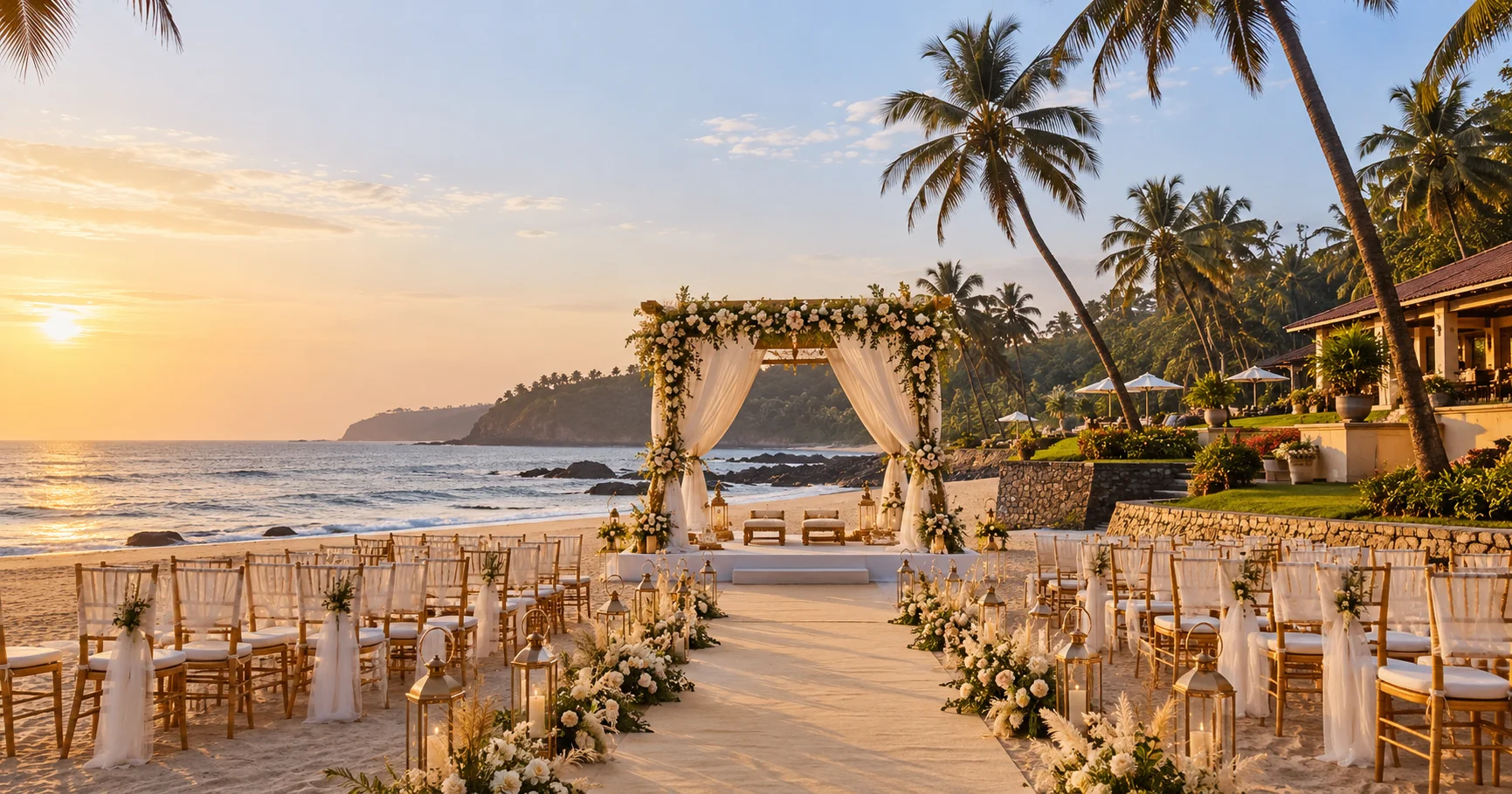
Everyone imagines the vows first and the paperwork never. But on a Goan beach, the paperwork decides whether your wedding actually happens where you pictured it. This guide breaks down exactly who controls Goa's beaches, what the rules really say, what a permit costs in 2026, and the step-by-step process to get one, so you are not the couple scrambling for an NOC three days before the wedding.
Quick Answer: What You Actually Need
If your ceremony is inside a resort's own licensed beachfront, lawn, or deck, the property usually arranges the required permissions as part of your booking. Confirm this in writing. If you want an open public stretch of sand, you normally need clearance from the Goa Coastal Zone Management Authority (GCZMA), permission through the Tourism Department's State Level Permissions Committee (SLPC) where the event falls outside licensed premises, a local Panchayat or Municipal NOC, and separate sound, police, fire, or excise permissions where applicable. For an open public beach approval package, keep a working budget of around Rs 1 lakh to Rs 2.5 lakh, depending on local fees and event scale. Start 60 to 90 days before the wedding, especially for peak season. Beaches such as Morjim, Galgibag or Galgibaga, Agonda, Mandrem, and Ashwem have extra restrictions because they are turtle nesting sites.
1. Do You Really Need Permission for a Beach Wedding in Goa?
Almost always, yes. Goa's coastline is not a free-for-all. It falls under the Coastal Regulation Zone (CRZ) framework, which restricts what can be built, placed, or hosted on the sand, and every stretch of beach sits under the jurisdiction of some combination of the Tourism Department, GCZMA, the local Panchayat or Municipal Council, and the Police. Whether you need a fresh permit or not depends entirely on where your ceremony takes place.If you are also checking legal marriage registration, read the civil marriage in goa guide separately.
| Scenario | Permission Needed? |
| Ceremony inside a resort's own licensed lawn, deck, or beachfront that falls within its property boundary | Usually handled by the resort under its own tourism and event licenses. Confirm this in writing before you sign a venue contract. |
| Ceremony on the open, public sand in front of a resort, but outside its licensed boundary | Yes. Separate GCZMA, Tourism Department, and local body clearances are required, even if the resort next door is helping with logistics. |
| Ceremony on a completely independent, non-resort public beach | Yes, and this route usually needs the most paperwork since there is no property owner to lean on. |
| Amplified music, DJ, or sound system anywhere near the beach | Always needs a separate sound permission, regardless of venue type. |
| Alcohol service outside a licensed premise | Yes, an excise license is required. |
Why this matters A wedding held without the right clearances is not just a legal risk. Enforcement teams have shut down or fined events for violating CRZ norms, especially near turtle nesting stretches, and a mid-ceremony intervention is the last thing any couple wants. Getting the paperwork right protects your day, not just your legal standing.
2. Who Controls Goa's Beaches: The Authorities Involved
Unlike a banquet hall booking, a beach wedding in Goa can touch four or five different government bodies. Here is who does what.
| Authority | What They Control |
| Goa Coastal Zone Management Authority (GCZMA) | The primary gatekeeper for any activity on the beach itself. Issues the core No Objection Certificate for holding an event on CRZ land, including temporary structures like mandaps, stages, and seating. |
| Directorate of Tourism, Government of Goa | Runs the single-window system and the State Level Permissions Committee (SLPC) for tourism-related events on public or unlicensed land, including many beach weddings. The SLPC reviews fire safety, security, traffic, and public amenity arrangements before granting approval. |
| Village Panchayat or Municipal Council (CCP for Panaji) | Issues a local NOC for events within its jurisdiction, especially if the beach access point, parking, or adjoining land falls under its control. |
| District Collectorate (North Goa or South Goa) | Issues the sound or loudspeaker permission, in coordination with the local Police Station. |
| Local Police Station | Provides law and order clearance, and its report often feeds into the sound permission approval. |
| Excise Department | Issues a temporary excise license if alcohol will be served outside an already-licensed premise. |
| Fire and Emergency Services | Sign-off needed if you are using open flames, fireworks, candle decor, or large temporary structures. |
| Goa State Pollution Control Board (GSPCB) | Occasionally relevant for waste handling and noise compliance on larger events. |
In practice, most couples do not personally visit every one of these offices. A wedding planner, a local event consultant, or the resort's in-house liaison team typically manages the applications on your behalf. But knowing who is involved helps you ask the right questions and spot a shortcut before it becomes a problem.
3. The Rules You Must Follow on a Goa Beach
Beyond the paperwork, there is a set of practical rules that shape how your ceremony can actually look and sound.
Sound and music cut-off
Amplified sound on an open beach generally has to stop by 10 PM under Goa's standard noise rules. If you want your reception to run later with a DJ or live band, you will usually need to move the party indoors to a soundproofed venue, or apply well in advance for special extended permission, which is not guaranteed.
No permanent structures
CRZ rules do not allow permanent construction on the beach. Mandaps, stages, seating, and lighting rigs must be temporary and fully removed once the event ends, usually within a set number of hours specified in your permit.
Public access must stay open
Goa's beaches are public land. Your event cannot block the general public's right of way to the shore, even during your ceremony hours. Permits typically specify the exact area you are allowed to use.
Plastic and waste rules
Goa enforces a single-use plastic ban. Decor, catering, and favours involving single-use plastic can invite fines. Clean-up and waste removal after the event is usually a condition of the permit, and failing to restore the site can affect future bookings on the same stretch.
Fireworks and open flame
Fireworks, sparklers, and open flame decor need explicit clearance from Fire Services, and are heavily restricted or denied outright on beaches close to turtle nesting zones during nesting season.
High tide line distance
Your permitted setup area will usually be defined in relation to the high tide line. Structures and heavy footfall too close to this line are a common reason for on-the-spot objections from enforcement teams.
Beach permissions are only one part of the legal side of planning a destination wedding. It is also important to understand the broader goa wedding legal requirements, especially if you are arranging your ceremony, marriage registration and other approvals in Goa.
4. Restricted Beaches: Turtle Nesting Zones
Not every beach in Goa is open for weddings, and this is the detail most guides skip entirely. Several stretches are officially notified turtle nesting sites under the CRZ framework, protecting the Olive Ridley turtle, a Schedule I species under the Indian Wildlife (Protection) Act.
| Beach | Status |
| Morjim | Notified turtle nesting site. Seasonal restrictions apply during the nesting period, usually around September or October to April, depending on current Forest Department and GCZMA directions. |
| Galgibaga (Turtle Beach) | Protected turtle nesting stretch. No event structure should be planned near marked nesting areas without current written clearance. |
| Agonda | Notified nesting site with seasonal restrictions on lighting, sound, shacks, and temporary structures. |
| Mandrem | Notified nesting beach, with restrictions on lighting and noise near nesting pits. |
| Ashvem | Notified nesting site with seasonal restrictions. |
During nesting season, expect strict controls on lighting, amplified sound, fireworks, vehicle movement, and temporary structures near marked nesting pits. GCZMA, the Tourism Department, and the Forest Department can refuse or restrict permissions on these stretches. If a beach on your shortlist falls into this category, ask your planner to check the current nesting-season status before you finalise the location. Once you know your chosen beach is suitable for the celebration, follow these beach wedding planning tips to plan the setup, timing, guest experience and other practical details around your beach ceremony.
5. Step-by-Step: How to Get Beach Wedding Permission
Step 1: Confirm the beach's jurisdiction and status
Find out whether your chosen stretch is resort-licensed, panchayat-controlled, municipal, or fully open public beach, and whether it falls in a turtle nesting zone. This single step decides how much paperwork you are in for.
Step 2: Apply for the GCZMA No Objection Certificate
For any event on open beach land or CRZ land, this is usually the most important application. GCZMA reviews the location, date, temporary structures, high tide line impact, public access, and expected footfall before issuing a No Objection Certificate.
Step 3: Apply through the Tourism Department's single-window system
Public or unlicensed tourism-related events are routed through the Tourism Department's single-window system and the State Level Permissions Committee (SLPC), where applicable. The committee reviews fire safety, security, traffic, parking, public amenities, site plans, and other event details. It ordinarily convenes within 15 days of receiving a complete application.
Step 4: Get the local Panchayat or Municipal NOC
The local body governing the access point, parking, or adjoining land needs to sign off separately, even after GCZMA and Tourism Department approvals are in hand.
Step 5: Apply for sound permission if you want music
File this with the concerned District Collectorate or Dy. Collector and SDM office. For beach locations, the sound permission application needs NOCs from GCZMA and the Tourism Department, so sequence it after those approvals, not before.
Step 6: Line up Police, Fire, and Excise clearances
Police clearance supports law and order and often feeds into your sound permit. Fire clearance is needed for open flame decor or fireworks. Excise clearance is needed if alcohol is served outside a licensed premise.
Step 7: Keep copies of every approval on-site
On the wedding day, keep printed or downloaded copies of all NOCs and permits with your event coordinator. Local enforcement or Forest Department staff can and do check for these, especially near sensitive stretches.
Step 8: Restore the site after the event
Remove all temporary structures, decor, and waste within the window specified in your permit. This protects your deposit if one applies, and keeps the door open for future events on the same stretch.
6. Documents You Will Need
- Application form for each authority (GCZMA, Tourism Department, Panchayat or Municipality, Collectorate for sound)
- Identity proof of the applicant (Aadhaar, Passport, or PAN)
- Wedding booking confirmation, invitation card, or venue booking receipt as proof of the event
- Site plan or layout showing the exact area, structures, entry and exit points, and seating
- Landowner's permission letter, or the resort's NOC if the beach adjoins a property
- Fire safety and disaster management plan for larger gatherings
- Vehicle registration details if vehicles will access the beach or nearby parking
- Details of amplified sound equipment and vendor, if applicable
- Proof of waste management or clean-up arrangement
- Demand draft or online payment receipt for the applicable fees
7. Cost Breakdown: What a Beach Wedding Permit Really Costs
This is the number every couple actually wants, and it depends heavily on whether you are using a resort's licensed frontage or an open public beach. Fees have changed in recent years, and proposals for further changes have also been discussed. Treat the figures below as the current working benchmark and always reconfirm with GCZMA, the Tourism Department, or your planner before budgeting.Permit costs should be added to your overall goa wedding cost for 50 guests or 100 guests, depending on your guest list.
| Permission or Fee | Approximate Cost |
| GCZMA beach event NOC (open, non-resort beach) | Rs 1,00,000 per event for a maximum period of five days, plus Rs 10,000 for every additional day after that event period. A 75 percent concession applies for eligible Government Corporation, autonomous body, charitable trust, school, institution, and sports event bookings. |
| Panchayat or Municipal event NOC | Around Rs 25,000 in jurisdictions that have standardised local event NOC fees, though this can vary by village. |
| Sound or loudspeaker permission | In North Goa, the listed application fee is Rs 50. In South Goa, the service page does not list a large event fee. The important point is timing: apply at least 15 days before the event, with beach NOCs attached. Permission may be granted close to the event date. |
| Police NOC | Usually nominal or no direct fee, but factor in time for the police report that supports your sound permission. |
| Fire safety NOC | A small fee is charged based on the size of your event and the setup required. . |
| Excise license for alcohol service outside a licensed premise | The price varies based on the quantity and rental period, but it is generally affordable. |
| Planner or consultant facilitation fee (optional) | Roughly Rs 15,000 to Rs 75,000 if you hire local help to manage the entire liaison process for you. |
| Realistic total for a public, non-resort beach wedding | Roughly Rs 1 lakh to Rs 2.5 lakh , depending on the beach, number of event days, and whether you use a facilitator. |
| Ceremony inside a resort's own licensed frontage | Often bundled into the venue package, or charged separately by the resort in the range of Rs 50,000 to Rs 1.5 lakh, well below open-beach costs since the property already holds most base licenses. |
Fees change, verify before you budget. The current Gazette benchmark is Rs 1,00,000 per event for a maximum period of five days, plus Rs 10,000 for every additional day after that event period. In 2025, GCZMA also discussed proposals for a fixed-stretch, multi-event permission model. Treat that as a proposal unless your planner confirms that it has been officially adopted for your specific date and beach stretch.For a larger celebration, compare this with the goa wedding cost for 100 guests.
8. Timeline: When to Start Applying
| Stage | Recommended Timing |
| Shortlist the beach and confirm jurisdiction and turtle nesting status | 3 to 4 months before the wedding |
| Submit GCZMA and Tourism Department (SLPC) applications | 60 to 90 days before, even though the Tourism guidelines allow minor events to apply at least 15 days in advance. Extra buffer is safer because GCZMA, local body, sound, police, and peak-season processing can add time |
| Panchayat or Municipal NOC | Alongside or right after the GCZMA and Tourism Department filings |
| Sound permission | At least 15 days before the event, once your beach NOC is in hand |
| Police, Fire, and Excise clearances | 2 to 4 weeks before the event |
| Final approvals and printed copies collected | 5 to 7 days before the wedding |
If your wedding falls in peak season, November through February, add extra buffer time. This is when the largest volume of applications hits every one of these offices at once.Your application timing should also match the best month to have a wedding in goa.
9. Resort Beach vs Public Beach: What Actually Changes
| Factor | Resort-Licensed Beach Frontage | Open Public Beach |
| Who applies | The resort, usually included in your contract | You, your planner, or a hired local facilitator |
| Typical cost | Bundled in venue price, or Rs 50,000 to Rs 1.5 lakh if charged separately | Rs 1 lakh to Rs 2.5 lakh, largely driven by GCZMA fees, local NOCs, sound permissions, fire or excise clearances, and facilitation costs. |
| Processing time | Days to a couple of weeks, since the property holds base licenses already | 4 to 8 weeks or more |
| Sound curfew | Same 10 PM outdoor rule applies, indoor after-parties possible | Same 10 PM rule, with fewer indoor backup options |
| Flexibility on decor and structures | More flexible within property norms | Stricter, since every structure needs to match the approved site plan |
For most couples planning from outside Goa, a resort-managed beach frontage is the lower-stress, lower-cost route. An open public beach makes sense mainly when a specific stretch is central to your vision and you have a planner experienced with local liaison work.Before choosing between a resort-managed beach or public beach, use this goa wedding venue checklist.
10. Common Mistakes Couples Make
| Mistake | Why It Backfires | How to Avoid It |
| Assuming the resort's beach frontage covers the whole visible stretch of sand | Resort licenses usually cover a marked boundary, not the entire beach in view | Get the exact boundary confirmed in writing before finalising decor and guest placement |
| Booking a turtle nesting beach without checking the season | Permission can be refused, or the event can be shut down mid-way | Confirm current nesting-season status for Morjim, Galgibaga, Agonda, Mandrem, and Ashvem before booking |
| Applying for the sound permit before the GCZMA and Tourism NOCs are ready | Sound permission for beach locations needs those NOCs attached | Sequence your applications correctly, GCZMA and Tourism first, sound permission after |
| Planning a DJ set past 10 PM on the open beach | Standard noise rules cut off amplified sound outdoors by 10 PM | Plan an indoor soundproofed after-party if you want music to run later |
| Skipping the clean-up and restoration step | Can affect deposit refunds and future permissions on the same stretch | Assign a dedicated vendor or team for post-event clean-up within the permitted window |
| Applying too close to the wedding date | SLPC and GCZMA both need real processing time, especially in peak season | Start applications 60 to 90 days ahead, not 2 to 3 weeks ahead |
These approvals are one reason many couples hire a wedding planner in goa for beach weddings.
11. Your Beach Wedding Permission Checklist
3 to 4 months before
- Shortlist your beach and confirm whether it is resort-licensed or open public land
- Check turtle nesting season status for the chosen stretch
- Decide who will manage the applications: you, your planner, or a local facilitator
2 to 3 months before
- File the GCZMA NOC application
- File the Tourism Department single-window (SLPC) application
- Apply for the Panchayat or Municipal NOC
- Prepare your site plan, fire safety plan, and vendor details
3 to 4 weeks before
- Apply for sound permission with GCZMA and Tourism NOCs attached
- Apply for Police, Fire, and Excise clearances as needed
- Confirm the concession eligibility if applicable
1 week before
- Collect and print all approved permits
- Brief your on-ground coordinator on the approved area boundary and sound cut-off time
- Confirm the clean-up team and timeline for after the event
Planning a Beach Wedding in Goa?
WedMyDay works with verified Goa venues and local teams who already handle these approvals season after season. We help you shortlist the right beach, understand what permission your venue actually needs, and keep your planning transparent from day one.
Final Thoughts: Get the Sand Right and the Rest Follows
A Goa beach wedding is one of the most photographed moments a couple will ever have, and it is worth protecting with the right paperwork. The good news is that none of this is complicated once you know the order of operations: confirm jurisdiction, secure GCZMA and Tourism Department approvals, get your local NOC, then layer on sound, fire, police, and excise clearances as needed. Start early, budget realistically, and choose a beach that is not fighting a nesting season against you.
Get this part right, and the only thing left to plan is how good the sunset looks behind you.