Goa is one of India's most popular destination wedding locations, and for good reason. Few places in the country give you sun-bleached beaches, Portuguese-colonial mansions, lush riverside estates, and dramatic clifftop venues in one state. But that abundance of choice is exactly why so many couples end up overwhelmed, overpaying, or worse, booking the wrong venue for their vision.
This checklist cuts through the noise. We've distilled hard-earned lessons from Goa wedding planning research, venue evaluation, and real couple experiences into 20 non-negotiable points you must evaluate before signing anything. Work through it systematically and you'll arrive at your venue decision with complete confidence.
Why Goa Remains India's Wedding Destination of Choice
Goa continues to remain one of India's strongest destination wedding choices in 2026. Wedding planning platforms and travel-led wedding guides consistently place Goa alongside leading domestic wedding destinations such as Jaipur and Udaipur. What makes Goa stand out is the combination of beaches, Portuguese-style heritage architecture, luxury resorts, private villas, hospitality infrastructure, and two operational airports serving the state.
Current public venue-budget guidance places many Goa destination wedding setups in the ₹30 lakh to ₹50 lakh range, while luxury celebrations can go much higher. The question is never whether Goa is right. It is which part of Goa, which type of property, and which checklist items will make or break your specific wedding.
The 20-Point Venue Checklist
1. Set Your True Budget Before You Visit Anything
Category: Foundation
This is the most skipped step, and the most expensive mistake. Before you open a single Instagram reel of beachfront venues, you must know your venue's total spend ceiling, not just the rental headline number. Accommodation often consumes 60-70% of a Goa wedding budget. If you are planning a mid-sized celebration, estimate your numbers with this goa wedding cost for 100 guests guide.
Venue rental costs in Goa range widely. Budget properties can start around ₹50,000-₹2,00,000 per day. Mid-range venues often sit between ₹2-8 lakh. Premium beachfront resorts or luxury villas can command ₹5-20 lakh and beyond. Understand which bracket you're in before you fall in love with something out of range.
Build your budget in this order: total budget, accommodation allocation at 60-65% of total, catering at roughly ₹1,200-₹3,500 per plate depending on property tier, venue rental as a standalone line item, decor, and everything else. Only approach venues once you know your accommodation budget ceiling.
If your budget is limited, you can read this guide on planning a budget wedding in goa under ₹10 lakhs before shortlisting venues.
| Budget Level | Approximate Range | Best Fit |
| Budget | ₹15-30L | 50-100 guests, smaller resorts, off-season |
| Mid-Range | ₹30-70L | 100-200 guests, boutique resorts, peak season |
| Luxury | ₹70L-1.5Cr+ | 200+ guests, 5-star properties, full buyout |
2. Choose Your Season Strategically
Category: Timing
Goa has three distinct wedding seasons. Your choice affects venue availability, pricing, weather risk, and overall guest experience more than almost any other decision you'll make.
Season affects cost, weather, and guest comfort, so check the best month for a Goa wedding before booking.
| Season | Months | What to Expect |
| Peak Season | November to February | Dry weather, comfortable evenings, strong demand, higher pricing, and faster venue sell-outs. |
| Shoulder Season | March to May and October | Warmer weather, manageable humidity, better availability, and more negotiable pricing. |
| Monsoon Season | June to September | Heavy rainfall, higher humidity, lower venue pricing, lush greenery, and a strong need for indoor backup. |
Watch Out: October in Goa is technically post-monsoon, but some years can still see unexpected rainfall. Always ask the venue for a micro-season rain plan.
3. Define Your Venue Type Before You Shop
Category: Vision
Goa offers a distinct spectrum of venue categories. Mixing up which type suits your vision is one of the fastest ways to end up disappointed. The five major categories are:
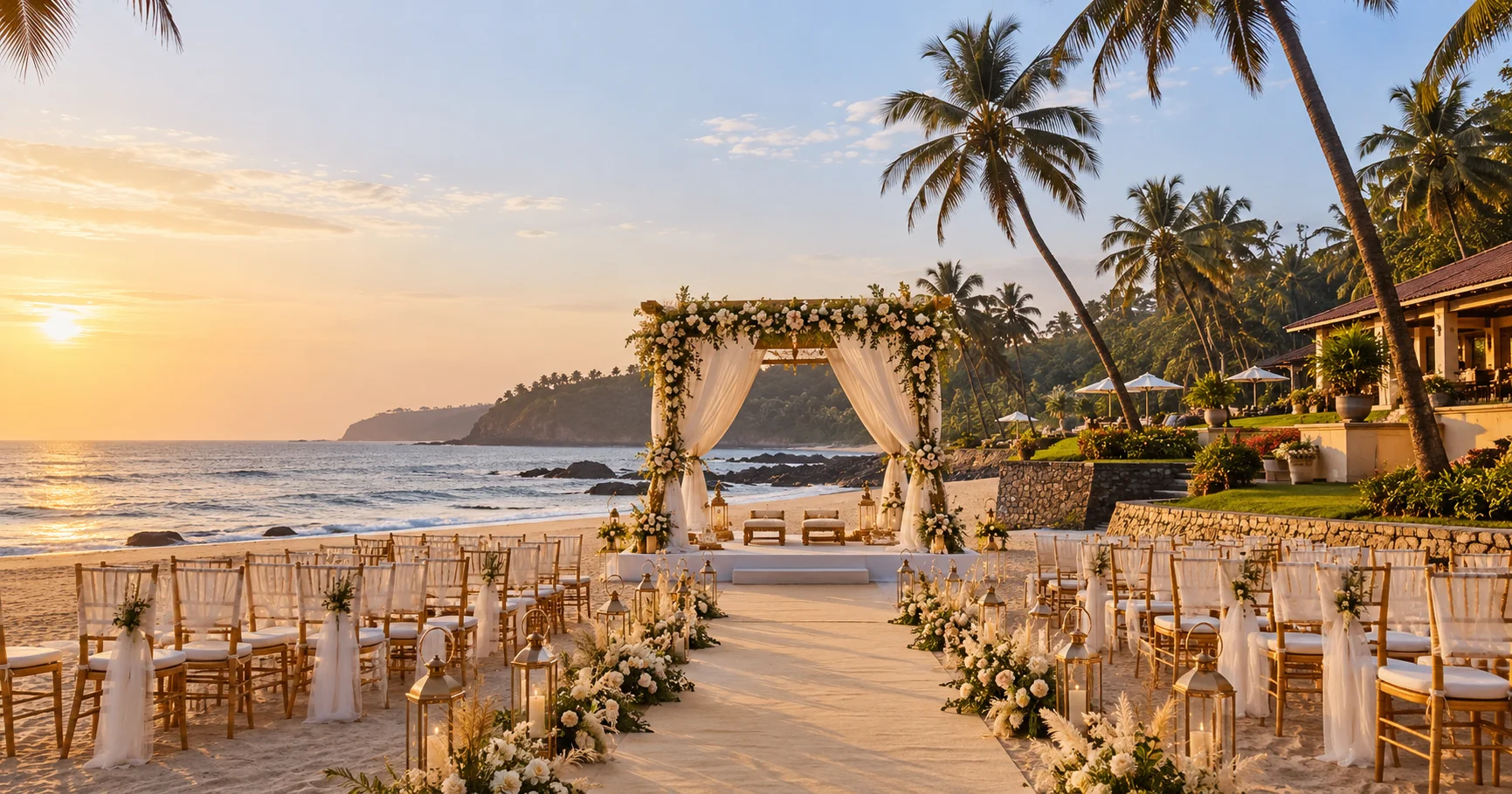
Beachfront Resorts: The Goa classic. Think sandy mandaps, ocean breezes, and sunset cocktail hours. Popular stretches include Candolim, Vagator, Palolem, and Arambol. These are ideal for couples who want the full Goa feel. Bear in mind that beach noise, wind, tourists on public stretches, and sound permissions can become real factors.
Heritage Portuguese Mansions: Tiled verandas, antique furniture, lush courtyards, and an atmosphere that photographs beautifully. These are often found around Fontainhas, Aldona, Assagao, and Saligao. They work well for intimate weddings of 50-150 guests. Many heritage venues may not have enough on-site accommodation, so you may need nearby hotel blocks.
Private Villas: A fast-growing choice for couples who want privacy and flexibility. You get exclusive buyout, full-property privacy, a pool, and more freedom to use your own vendors. Luxury villas in North Goa areas such as Siolim, Assagao, and Vagator can suit intimate to mid-sized celebrations depending on the property.If you are planning a smaller villa or boutique resort celebration, compare your numbers with the goa wedding cost for 50 guests.
Luxury Resorts & 5-Star Hotels: W Goa, Alila Diwa Goa, The St. Regis Goa Resort, Grand Hyatt Goa, and Taj Holiday Village Resort & Spa are examples of this category. These properties offer full-service support with in-house catering, decor teams, and event coordinators. The trade-off is less flexibility to bring outside vendors, minimum food and beverage guarantees, and more structured packages.
Riverside & Inland Estates: Lesser-known but spectacular. Properties along the Mandovi and Sal rivers, or inland around the spice plantation belt of South Goa, can offer dramatic scenery with less competition for dates.
4. Match Venue Capacity to Your Guest Count Carefully
Category: Capacity
This sounds obvious, but the right capacity calculation is more nuanced than it appears. A venue that holds 300 guests at cocktail density might feel suffocating at a sit-down dinner for 200. Always ask three separate capacity figures: maximum standing cocktail, comfortable banquet or dining, and comfortable ceremony seating.
The golden rule is simple. Choose a venue that can handle your guest count at 20-25% below its theoretical maximum. This gives you breathing room for a dance floor, a live band setup, a photo booth, a dessert station, and all the elements that transform a dinner into a wedding experience.
For micro-weddings under 75 guests, a private villa is often better value than a large resort. You get exclusivity, intimacy, and flexibility without paying for empty banquet hall space.
For intimate celebrations, this list of small wedding venues in goa under 50 guests can help.
5. Location: Airport Proximity & Guest Accessibility
Category: Logistics
Goa is served by two airports: Goa International Airport at Dabolim in South Goa, and Manohar International Airport at Mopa in North Goa. Dabolim operates as a civil enclave at the INS Hansa naval airbase. Mopa has improved access to North Goa and continues to expand the state's air connectivity.
Flight schedules and routes can change by airline and season, so map guest arrivals against both airports before finalising the venue. North Goa areas such as Candolim, Calangute, Baga, Vagator, and Assagao are generally closer to Mopa and farther from Dabolim. South Goa areas such as Cavelossim, Benaulim, and Varca are generally closer to Dabolim and farther from Mopa.
If you're still deciding which part of Goa is right for your celebration, read this north goa vs south goa wedding guide for a detailed comparison.
Watch Out: Several stunning venues in Goa are located down narrow lanes that cannot accommodate large buses or multiple coaches at the same time. If you're planning shuttle services for guests, test the access road before you sign.
6. On-Site Accommodation: Rooms, Room Blocks & Buyouts
Category: Staying Over
Accommodation is the single largest budget line item in many Goa weddings. The question is not just whether the venue has rooms, but how the accommodation arrangement works commercially and practically.
Three models exist.
First, full property buyout, where you rent all rooms for the duration and get exclusive access. This is typical of villas and boutique properties.
Second, room block with minimum commitment, which is common at large resorts. You guarantee a minimum number of room-nights and guests book at a contracted rate.
Third, no on-site accommodation, which is common with heritage mansions and standalone lawns. In this case, you arrange nearby hotel blocks separately.
For a destination wedding where most guests are travelling, on-site accommodation is almost always preferable. It removes transport logistics at 2 AM, keeps the energy contained, and creates a far more memorable multi-day experience for your guests. If on-site rooms are limited, choose a venue within 10 minutes of a hotel cluster where you can block rooms easily.
For a 100 guest wedding, room blocks can become the largest cost driver, so check the goa wedding cost for 100 guests before negotiating with resorts.
7. Evaluate Both Outdoor and Indoor Spaces
Category: Spaces
A Goa wedding typically spans 2-3 days and multiple events: a welcome cocktail dinner on day one, a main ceremony and reception on day two, and often a farewell brunch. Each event may need a different space configuration. Do not just visit and evaluate the main event venue. Walk through every space, understand the flow between them, and visualise each segment of your wedding itinerary.
Great Goa venues offer a layered experience. You may have an ocean-facing lawn for the ceremony, a covered pergola or terrace for cocktails, and a banquet hall or grand tent structure for dinner. Single-space venues force every event into the same setting, which can feel repetitive over a 3-day celebration.
For outdoor spaces, ask about the ground surface. Grass, sand, and paved surfaces all affect decor anchoring, stiletto-wearing guests, and elderly relatives navigating the space. Also ask about shade availability and whether the property's trees will interfere with fairy light rigging or mandap installations.
8. Venue Exclusivity: Will You Share the Property?
Category: Privacy
This is a deal-breaker question that many couples forget to ask. Large resorts frequently host multiple events at the same time. A corporate conference in Hall A can happen while your reception is in the poolside lawn. This is legal, common, and can undermine the intimacy and atmosphere you're paying for.
Always ask explicitly: Will any other events, conferences, or large group bookings be taking place at the property during our wedding dates? Get the answer in writing, in the contract. If the venue says they can accommodate your request for exclusivity but will not commit to it contractually, assume it may not happen.
Private villas inherently offer exclusivity. It is the defining feature of the category. Boutique heritage properties also tend to work as full buyouts. With larger resorts, exclusivity can sometimes be negotiated but typically carries a premium of 15-30% on venue rental.
Watch Out: Exclusive use of the wedding venue is not the same as exclusive use of the property. Make sure you understand which spaces are included and whether public-access areas such as the beach, pools, or restaurant remain open during your events.
9. Catering Policy, Per-Plate Costs & Minimum Guarantees
Category: Food & Beverage
In Goa, catering arrangements usually fall into three models. First, in-house catering only. The venue requires you to use their kitchen and food and beverage team. This is the most common arrangement at hotels and resorts. Second, an approved caterer list. You choose from a panel of vetted external caterers. Third, open caterer policy. You bring whomever you want, though the venue may charge a kitchen usage or vendor access fee. Know which model applies before you fall in love with a venue.
Per-plate catering costs in Goa typically run ₹1,200-₹1,800 for a decent vegetarian spread at budget resorts, ₹2,000-₹3,500 at mid-range properties, and ₹4,000-₹8,000+ at luxury 5-star venues. These numbers cover food only. Beverages, bar setup, taxes, and service charges are additional.
Always do a food tasting before signing. Ask to taste the actual banquet menu, not the a la carte restaurant menu, which may be handled differently. Request at least 5-6 dishes representing the cuisine types you plan to serve.
10. Decor Flexibility & External Vendor Policies
Category: Aesthetics
The decor can transform even a mediocre venue into a breathtaking space. It can also be capped, controlled, and commodified by an inflexible property that insists on using its in-house team at inflated rates. Before committing to any venue, understand the vendor policy in full.
Specifically, ask: Can I bring my own floral decorator? Is there a per-person or per-vehicle charge for external vendors entering the property? Are there height restrictions on mandap structures or floral arches? Can I hang lighting from trees, pergolas, or ceiling structures? Is there a curfew on decor setup? Some venues allow setup from 10 PM to 7 AM only, which is difficult for complex installations.
Many Goa venues have commercial relationships with decor companies and will push you toward their preferred vendors. This is not always bad. Some of the best floral designers in the country work in Goa. But you should have the freedom to use the decorator of your choice without punitive surcharges.
Watch Out: Some properties charge ₹50,000-₹2,00,000 simply to allow an external decorator on-site. This is a growing practice in premium venue circuits. Factor it into your budget comparison.
As you compare wedding venues, keep a record of their answers so you can review the options later without forgetting important details.

11. Music Curfew, Sound Limits & DJ Policies
Category: Entertainment
Goa has some of the most celebrated nightlife in India, but official noise regulations are strict. Under the Noise Pollution rules and Goa's action plan, daytime is treated as 6 AM to 10 PM and night time as 10 PM to 6 AM. Loudspeakers, public address systems, musical instruments, and sound amplifiers are generally not permitted at night except in closed premises, approved venues, public emergencies, or on notified special days with permission.
In 2026, Goa notified limited special-day permissions for loudspeakers between 10 PM and midnight on specific cultural and religious occasions. For most private weddings, treat 10 PM as the safe outdoor music cut-off unless the venue has clear written permission and an approved setup.
This is a genuine deal-breaker for couples planning late-night receptions. Ask the venue point-blank: What is your practical sound curfew? Has it ever been enforced on a wedding night? Also ask whether they have an approved indoor or closed space where the party can continue after outdoor music winds down.
For beach ceremonies, live sound amplification may require separate permission from local authorities. Many established venues have this process planned. Others do not. The absence of permission can mean no PA system for your vows, which is a detail you do not want to discover on the morning of your wedding.
12. Permits, Permissions & Local Compliance
Category: Legal
Goa's regulatory environment for events is more complex than most couples realise. It is usually the venue's responsibility to hold the right permissions, but it is your wedding that gets affected if they do not.
Key documents to verify include: event permission or NOC from the relevant panchayat, municipality, police, collector, or other local authority as applicable; fire safety NOC for events with pyrotechnics, open flames, or large covered structures; sound permission for outdoor amplified music; liquor service licence or temporary event permission from Goa Excise if alcohol is served; and CRZ compliance for coastal venues.If the ceremony uses open beach space, read this beach wedding permission in goa guide before signing the venue contract.
CRZ compliance matters because the Coastal Regulation Zone framework applies to seafront land from the High Tide Line up to 500 metres on the landward side. Tidal-influenced rivers, creeks, and backwaters can follow different distance rules. Any stage, tent, mandap, beach setup, temporary structure, or construction-related installation near the coast should be checked with the venue and local authorities.
Ask the venue to show you documentation, not just tell you they have it. Any reputable property should be willing to explain its compliance position. If they are evasive, that is a significant red flag.If your venue includes open beach space, check the beach wedding permission in goa process before signing.
Watch Out: Drone videography is not automatically cleared. Drone use in India must follow the Drone Rules, 2021 and the Digital Sky airspace map. Green zones are easier, yellow zones require permission from the relevant air traffic control authority, and red zones require central government permission. Since Goa has two airports and several sensitive zones, ask your photographer to check the current Digital Sky map before promising drone shots.
13. Monsoon & Rain Contingency: What's Plan B?
Category: Weather Risk
Even in peak season, Goa can experience unexpected showers. If you're planning a beach ceremony or an outdoor dinner under the stars, you need to know exactly what happens when it rains. Not a vague we'll figure it out. You need a specific, detailed, already-operational contingency plan.
The best venues have a permanent covered structure, not a makeshift tarp, that can host the same number of guests as the outdoor space, with lighting and sound pre-rigged for the transition. Ask to see the indoor backup during your site visit. Walk through it physically. Imagine your wedding happening there without any of the outdoor magic. If you can still see yourself having a wonderful evening in that space, the venue passes the rain test.
Confirm how quickly the transition can happen. You want under 20-30 minutes. Ask whether the decor contractor knows the backup plan and has costed it. Also ask whether there is an additional cost to activate the indoor backup. Some venues charge extra for generator usage or indoor climate control during an unplanned transition.
14. Power, Lighting & Generator Backup
Category: Infrastructure
Power cuts can happen in Goa, including in peak season. Every wedding venue should have generator backup, but not all generators are created equal. A common nightmare scenario is simple: the main power trips at 9 PM, the generator kicks in, but it can only power emergency lighting and not the DJ equipment or mood lighting installation. Your party effectively ends.
Ask specifically: What is the generator capacity in KVA? Does it cover 100% of event load, including sound, lighting, kitchen, and air conditioning? How quickly does it cut in after a power failure? Anything over 10 seconds can mean a total blackout during the switchover. Has there been a power cut during a wedding in the past year, and how was it handled?
Also verify the venue's lighting infrastructure. Premium Goa venues often have ambient lighting rigs, fairy lights in trees, uplighting on architectural features, and warm pathway lighting. Others are bare and require your decorator to build lighting from scratch, which adds significantly to both cost and setup time.
15. Restrooms, Changing Rooms & Guest Amenities
Category: Guest Comfort
This is unglamorous but essential. Nothing disrupts a 200-person wedding faster than six restroom stalls. Count the permanent restroom facilities at the venue and apply a simple rule of thumb: you need one usable stall per 25 guests at minimum, ideally one per 15-20 guests for a dignified experience.
For outdoor venues, ask about portable luxury restroom trailers. These are widely available from Goa event rental companies and can be deployed to supplement permanent facilities. Premium restroom units include air conditioning, proper lighting, and running water. Budget versions are not the same experience. Budget for the premium version if guest comfort matters.
Also ask about a dedicated bridal changing suite and green room, a separate groom's room, a makeup artist workspace with proper lighting and mirrors, and a secure area for gifts and personal belongings.
16. Parking Capacity & Guest Transport Planning
Category: Logistics
For a destination wedding where most guests are staying on-site or nearby, parking is less critical because most will walk or take a short transfer. But if any of your guests are day-visitors, local family driving in, or you're hosting a ceremony at a church followed by a reception at a separate venue, parking becomes logistically significant.
A reasonable rule is to plan for one car per three to four guests on a destination-wedding guest list. Ask the venue: How many cars can they accommodate? Is there overflow parking nearby? Do they provide parking attendants? On narrow lanes in North Goa, valet management is effectively mandatory. Cars stacking on a single lane leading to the venue can create chaos at start times.
If you're running shuttles between accommodation clusters and the venue, test the route at the time of day your shuttle will run. Goa's coastal roads during sunset are beautiful and congested. A shuttle that takes 12 minutes at noon can take 40 minutes at 6 PM during December.
17. Contract Terms, Deposits & Cancellation Policy
Category: Legal
The venue contract is the most important document of your entire wedding planning process. Read it fully, not just the pricing sheet. Hire a lawyer for ₹5,000-₹15,000 to review it if the total venue spend exceeds ₹10 lakh. This is money well spent.
Key clauses to scrutinise include deposit structure, force majeure, cancellation by the couple, cancellation or changes by the venue, and price revision clauses. Most Goa venues require 25-30% to hold the date and 50-75% by 3-4 months before the event. Understand exactly when each payment is due.
For force majeure, ask what counts as a force majeure event. COVID taught the wedding industry painful lessons here. Make sure the clause is balanced, not entirely one-sided in favour of the venue. For cancellation by the couple, understand your refund entitlements at 12, 6, 3, and 1 month before the event. For cancellation by the venue, ask whether a refund is the only remedy or whether the venue accepts responsibility for consequential losses. Also confirm whether the venue can revise per-plate or accommodation costs after signing.
Watch Out: Be extremely wary of any venue that refuses to put verbal commitments in writing. Don't worry, we'll take care of it is not a contractual commitment. If they said it, it should be in the contract. No exceptions.
18. Site Visits & Real-Couple References
Category: Due Diligence
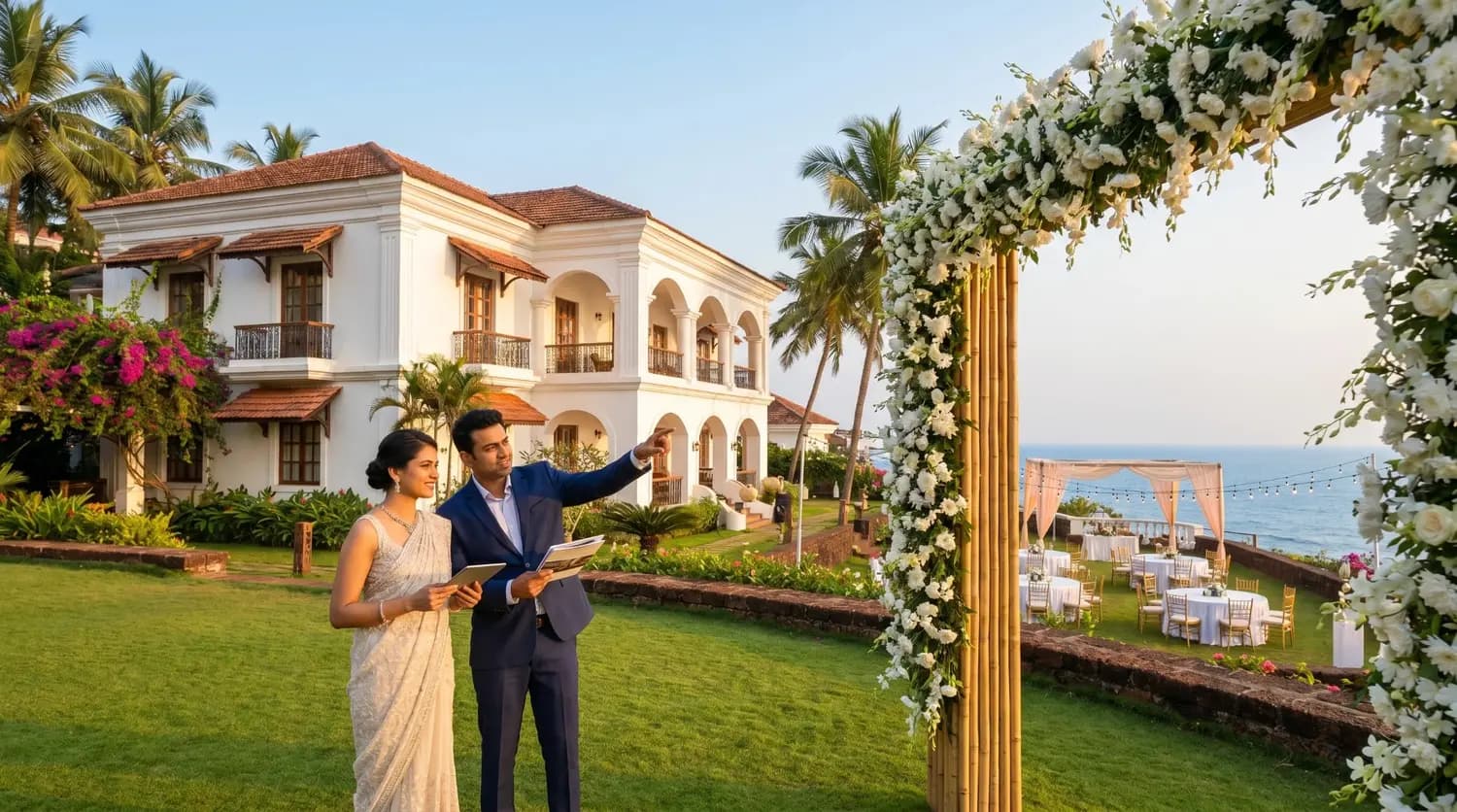
Never book a Goa wedding venue without a physical site visit if it is possible. Photos are extensively curated and often shot in perfect conditions that your guests will not experience. Visit at the time of day your wedding events will occur. If you're planning a 7 PM ceremony, visit at 7 PM. See how the light falls, whether the adjacent road is noisy at that hour, and where the sun sets relative to your mandap position.
Ask the venue for references from at least two to three couples who celebrated there in the past 12 months, with a guest count similar to yours. Call them. Ask about the catering quality on the actual wedding day, staff responsiveness during the event, any surprises or letdowns, and whether they would book the venue again. Most couples are genuinely helpful and candid.
Also search for the venue on wedding forums, Instagram hashtags, and WedMyDay's own verified reviews. Look specifically for complaints about food quality on the event day compared with the tasting, surprise charges not in the original quote, venue management responsiveness after booking, and issues with external vendor access.
19. Dedicated On-Site Coordinator: A Non-Negotiable
Category: Day-Of Execution
Every premium Goa venue should assign you a dedicated event coordinator. This should not be a generic events manager shared across three simultaneous events. It should be a specific person whose core responsibility on your wedding day is to ensure everything runs as planned at that property.
Ask to meet this person during your site visit. Gauge their experience, their communication style, and their knowledge of the specific property. Ask them: What is the most common thing that goes wrong at weddings here, and how do you handle it? Their answer will reveal more about their actual competence than any brochure will.
This coordinator is your bridge between your wedding planner and the property operations. They should know the electrical breaker locations, the emergency contacts for the chef, the contingency timeline for a rain event, and the curfew enforcement history at the venue. If the venue cannot tell you who your coordinator will be, or if they say they will assign someone closer to the date, push back firmly.
20. The Final Gut Check: Does This Feel Like Your Wedding?
Category: The Intangible
Every item on this checklist is rational, measurable, and contractual. But there is one final criterion that defies quantification, and it matters more than the sum of all the others. When you stand in that venue space, close your eyes for ten seconds, and imagine your people filling it up, does it feel like you?
The best venue for a close friend's wedding might leave you cold. A heritage mansion that looks average in photos might take your breath away on a Tuesday morning site visit when the light comes through the courtyard tiles just right. A beachfront space that looked perfect in a magazine might feel overwhelming and impersonal when you stand in it and imagine your 80-year-old grandmother making her way to her seat.
Run through every point on this checklist. Get your contracts reviewed. Do your due diligence on every number. And then trust your instinct. The right Goa wedding venue does not just accommodate your wedding. It becomes part of the story you tell for the rest of your lives.
The WedMyDay Standard: If a venue checks at least 18 of these 20 points and fails only on minor items, perhaps parking is tight or the on-site rooms are limited, it is likely still a strong choice if the fundamentals are solid. Those fundamentals are budget, exclusivity, backup plan, and contract terms. No venue is perfect. But the right one will be extraordinary.
Your Quick-Reference Summary
Use this as your on-site visit checklist. Screenshot it, print it, or share it with your partner.
- Budget ceiling set with contingency
- Season confirmed and weather plan in place
- Venue type matches wedding vision
- Capacity verified across all event formats
- Airport proximity and road access checked
- Accommodation model negotiated
- All spaces walked through physically
- Exclusivity guaranteed in writing
- Food tasting completed and signed off
- Vendor policy and external fees understood
- Music curfew confirmed in writing
- All permits and licences verified
- Indoor backup plan inspected physically
- Generator capacity verified for full event load
- Restroom count adequate for guest list
- Parking or shuttle plan confirmed
- Contract reviewed by lawyer if large
- Site visit done at event time of day
- References from 2-3 recent couples called
- Gut check completed: this feels like our wedding