

You live in London, New York, or Dubai. Your family and your venue are in Jaipur. Somewhere between two time zones, three currencies, and a hundred WhatsApp messages, you are trying to plan a wedding you cannot always see in person.
That is the real challenge of an NRI wedding in Jaipur. The hard part is everything around the venue: the paperwork that makes your marriage legally clean in two countries, the visas your guests need, the vendor payments that cross borders, and the calls you schedule early in the morning or late in the evening because India is 1.5 to 13.5 hours ahead of your planning base.This guide covers all of it.
Planning from abroad becomes easier when venue decisions, guest travel and pending bookings are organised in one place.

Why NRI couples keep choosing Jaipur
For NRI couples specifically, three things matter more than they would for a wedding within India:
- Vendor familiarity with foreign guests: Jaipur's wedding industry has hosted NRI weddings for years, so venues and vendors are used to virtual walkthroughs, international payment methods, and guests who need dietary or accessibility accommodations.
- Connectivity: Jaipur is about a 4 to 5 hour drive from Delhi, one of the best connected long haul airports in the world, and it has useful direct Gulf routes, especially to the UAE.
- Value: Hosting in Jaipur usually costs a fraction of an equivalent scale event in the UK, US, or UAE, which means the same budget stretches to a bigger venue, longer celebration, and more guests.
If you want to see venue categories and real pricing, our Jaipur destination guide and jaipur wedding venue listings are a good next stop after this article.
The legal side: how NRI marriages actually work in India
This is the section most blogs either skip or get vague on purpose, because it genuinely depends on your situationHere is how it breaks down.
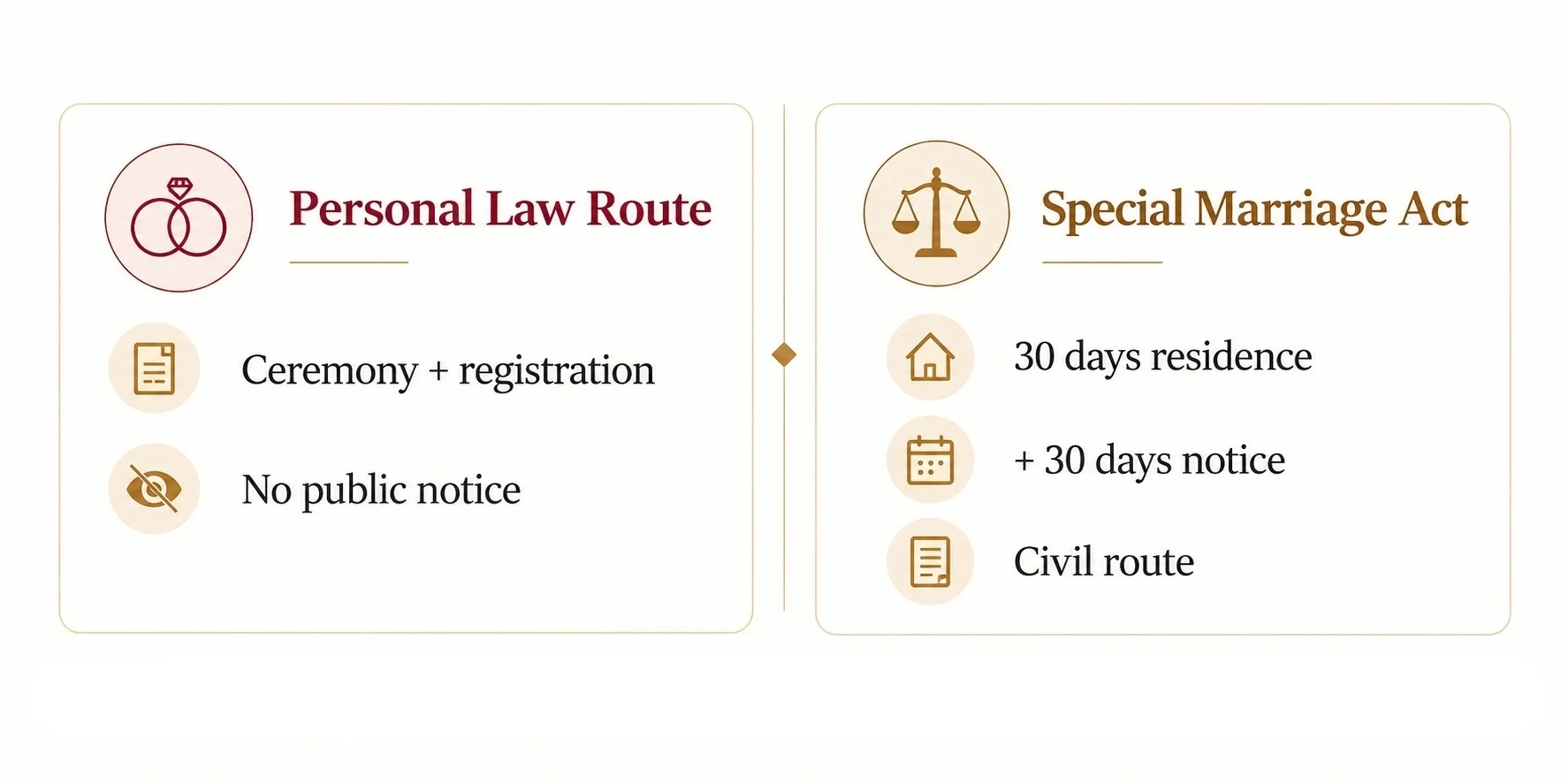
Path 1: Both of you are of Indian origin (the common case)
If both partners are of Indian origin and follow the same religion, the 30-day notice may not apply. They can marry through the relevant religious ceremony, such as under the Hindu Marriage Act for Hindu, Sikh, Jain, or Buddhist couples.
After the ceremony, marriage registration is still important because the certificate is needed for passport updates, visa work, joint accounts, and immigration purposes. Other personal laws have their own process.
Path 2: One of you is a foreign national, or you want a civil marriage
If you choose a secular civil marriage route, including many interfaith and foreign-national cases, the Special Marriage Act, 1954 applies. This is where the 30 day notice period people mention actually comes from, and it is stricter than most summaries suggest.
A foreign national marrying under this Act generally needs a valid visa with enough remaining validity at the time of marriage, along with an apostilled certificate proving they are legally free to marry. As of the current central marriage laws, the bridegroom must be at least 21 and the bride at least 18.
Country by country: proving you are single
Every country calls this document something different, and the process to get one varies a lot between the UK, the US, and the UAE.
| Country | Document | Where to get it | Typical process |
| United Kingdom | Certificate of No Impediment (CNI), affirmation, or statutory declaration, depending on what the Indian authority asks for | Your local Register Office or the route shown by GOV.UK for marriage abroad | The UK process can involve a notice period before a CNI is issued. British offices in India no longer issue a marriage NOC, so check GOV.UK and get the required UK document apostilled through the Foreign, Commonwealth and Development Office if the Indian authority asks for it. |
| United States | Single Status Affidavit, sometimes called a Certificate of No Marriage Record or Affidavit of Marital Status | A notary public or county clerk's office (there is no single federal document) | The sworn affidavit is notarized, then apostilled through the US Department of State or the relevant state authority. |
| United Arab Emirates | Depends on your citizenship, not your residence | Your home country's embassy or consulate in the UAE, if you are a UK or US citizen living there | A UK or US passport holder living in the UAE still uses their home country's document and the apostille route. The non-apostille route only applies to documents actually issued in the UAE, or documents that will be used inside the UAE later. |
If you are still comparing Jaipur with a beach destination, this goa vs jaipur destination wedding comparison will help you make a clearer decision.
Apostille or attestation: know the difference
UK, US, and India are part of the Hague Apostille Convention, so many UK or US documents can be apostilled once and used in India. The UAE is different because it is not part of this apostille system.
So UAE-issued documents, or documents you may need to use in the UAE later, usually require full attestation through the proper authorities, including UAE embassy or consulate legalisation and MoFA stamping. This process takes longer than a simple apostille, so UAE-based couples should start paperwork early.
Using your Indian marriage certificate back home
A marriage legally performed in India is usually accepted in the UK and US without marrying again. Still, you may need a certified copy or apostille of the Indian marriage certificate for banks, employers, immigration, or visa work.
For the UAE, the process is different. Since UAE is not part of the apostille system, the Indian marriage certificate usually needs attestation from the Indian Embassy or Consulate and then UAE MoFA.Before filing, check with the Jaipur marriage registrar, your embassy, or a family lawyer for current rules.
Visas and entry rules for you and your guests
If you or your guests hold an OCI card
An Overseas Citizen of India card holder never needs a visa to enter India. The OCI card gives lifelong, multiple-entry travel rights to India, subject to current OCI conditions. The one thing to watch is the current OCI update requirement: OCI holders must upload renewed passport details and a recent photo through OCI Miscellaneous Services within three months of receiving a new passport.
Physical reissue is required only in limited cases, such as when a card issued to a minor needs to be updated after the person turns 20 and receives a new passport.
If your guests need a tourist e-visa
Guests who are not OCI holders will need an Indian e-Tourist visa.
There are three common e-Tourist visa durations:
- 30 Days
- 1 Year
- 5 Years
30-day e-Tourist visa is usually double-entry, while the 1-year and 5-year options are multiple-entry. One detail worth knowing: citizens of the UK, the US, Canada, and Japan are permitted a continuous stay of up to 180 days per visit under the 1 year and 5 year e-Tourist visa, while most other nationalities are capped at 90 days per visit. India has also introduced an e-Arrival Card requirement. From October 1, 2025, foreign nationals, including OCI cardholders, are expected to complete it online within 72 hours before arrival.
For shorter answers around venue booking, guest travel, season, and local planning, you can also explore the Jaipur wedding FAQ open while finalising the basic plan.
Getting everyone to Jaipur
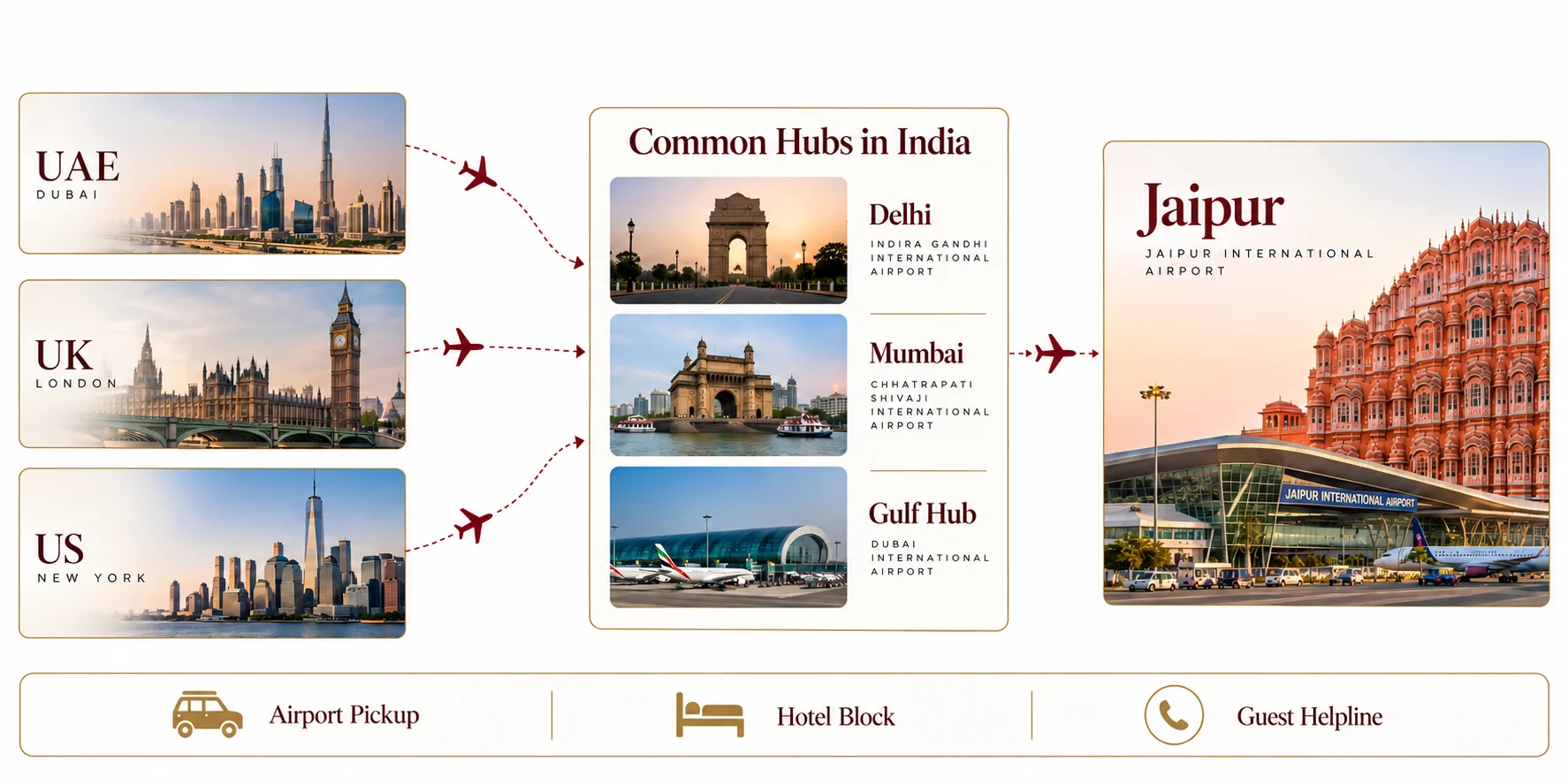
Flight planning looks different depending on where your guests are flying from, and this is where a lot of first time NRI couples get caught out.
- From the UAE: Jaipur airport has useful direct Gulf connectivity, especially UAE routes such as Dubai, Sharjah, and Abu Dhabi, run by a mix of full service and low cost carriers. Some schedules also list Muscat, so always check the live airline timetable before issuing guest travel guidance. This is genuinely the easiest guest group to plan for, since they can fly straight into Jaipur with no connection.
- From the UK and the US: There are currently no nonstop Jaipur flights to Europe or North America. Guests will connect, either through Delhi or Mumbai, or through a Gulf hub like Dubai or Abu Dhabi on Emirates or Etihad, with an onward domestic or connecting flight into Jaipur.
- An alternative worth considering: Since Delhi is only a 4 to 5 hour drive from Jaipur, some UK and US guests, especially larger families or older relatives, prefer flying into Delhi on a long haul carrier and completing the last leg by road or a short domestic hop, rather than juggling a second connection.
For guests who have never travelled to India before, that single point of contact does more for their comfort than almost anything else you plan.If you are still unsure how much can be handled remotely before you fly in, this guide on how to plan a destination wedding in India without visiting explains the remote planning process step by step.
Money, currency and paying Indian vendors from abroad
A destination wedding in Jaipur typically ranges from about INR 25 lakh for a smaller, simpler celebration to well over INR 2 crore for a large multi day palace wedding. Most weddings for 100 to 150 guests land between INR 20 lakh and 70 lakh. Using rounded 2026 planning exchange assumptions, that roughly translates to:
| INR | Approx. GBP | Approx. USD | Approx. AED |
| 25 lakh | ~19,500 | ~26,300 | ~96,000 |
| 70 lakh | ~54,700 | ~73,700 | ~269,000 |
| 1 crore | ~78,100 | ~105,300 | ~385,000 |
| 2 crore | ~156,300 | ~210,500 | ~769,000 |
For detailed venue-wise and guest-count-wise numbers, read our destination wedding cost in jaipur guide.
How payments actually move
Most couples pay Indian vendors through a straightforward bank wire transfer, or through a forex remittance platform, sent directly to the vendor's business account. Agree the currency of the contract upfront. Some vendors quote in INR, some are open to quoting in GBP, USD, or AED for NRI clients, and the difference matters once exchange rates move between booking and final payment. A buffer of 5 to 8 percent on top of your quoted budget is a sensible cushion against currency movement alone.
A common point of confusion is India's Tax Collected at Source rule on foreign remittances. That rule applies to Indian residents sending money out of India under the RBI's Liberalised Remittance Scheme. It does not apply to you sending money from your UK, US, or UAE account into India to pay a vendor, since that is an inward remittance in the opposite direction.
Solving the time zone problem
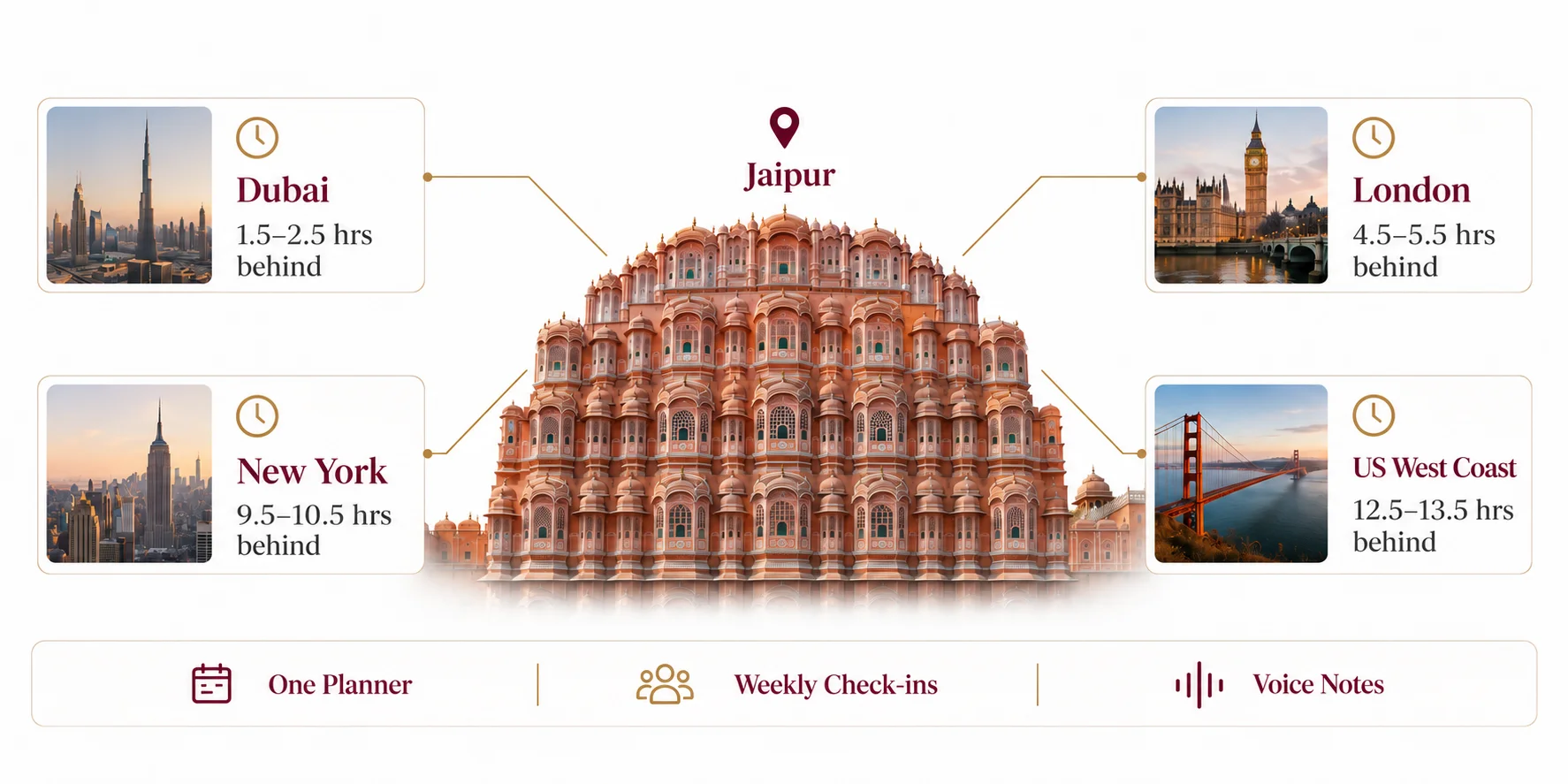
Coordinating with vendors in real time is one of the more underestimated parts of planning from abroad. Here is roughly how the time difference plays out.
| Your location | Roughly behind India by | A good call window (India time) |
| United Arab Emirates | 1.5 hours | Almost any normal working hour overlaps comfortably |
| United Kingdom | 4.5 to 5.5 hours | Late afternoon to evening in India lines up with UK midday to early afternoon |
| US East Coast | 9.5 to 10.5 hours | Early morning in India lines up with the previous evening on the US East Coast |
| US West Coast | 12.5 to 13.5 hours | Late morning in India lines up with the previous evening on the US West Coast |
The practical fix is not a perfect overlap, it is reducing how often you need one. Two things help more than any scheduling trick: putting one dedicated planner or point of contact between you and every individual vendor, so you are not juggling five separate WhatsApp threads across three time zones, and relying on asynchronous updates, recorded venue walkthroughs, shared photo folders, and voice notes, for anything that does not truly need a live call. Save the live calls for decisions that genuinely need back and forth, and set a fixed weekly check in time rather than arranging calls ad hoc.
When to get married: Jaipur's seasons
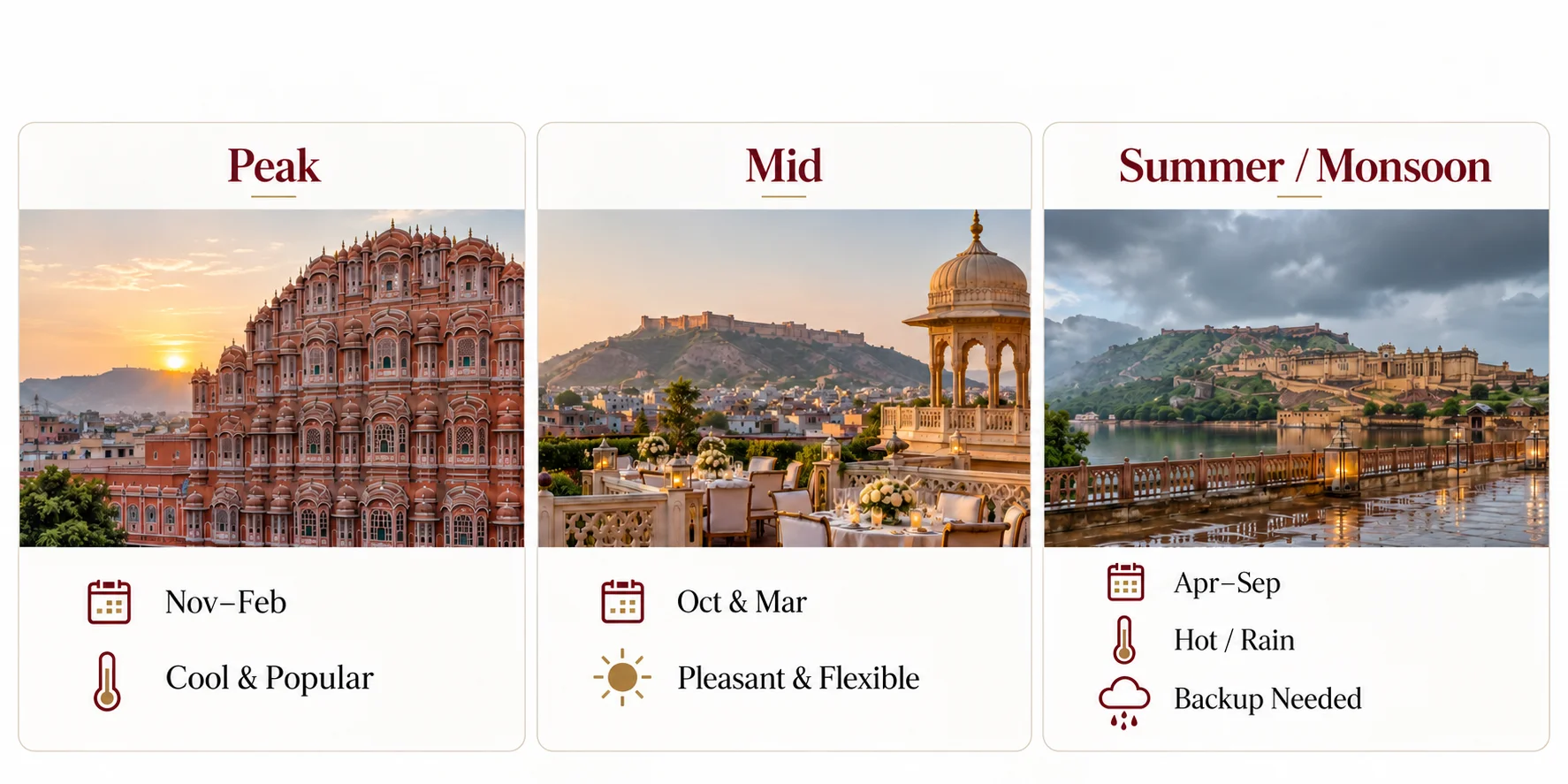
Jaipur's wedding calendar splits into three practical windows.
- November to February (peak season): Cool, pleasant weather that suits outdoor courtyard ceremonies, poolside haldi functions, and evening receptions without heat management. This is also when venues are booked earliest and priced highest, so an 8 to 12 month lead time is realistic for popular palace properties.
- October and March (mid season): Still pleasant, generally better availability, and often a bit more flexibility on venue terms.
- April to September (summer and monsoon): Lower demand and better rates at many properties, but daytime heat and monsoon rain mean outdoor functions need a solid indoor or shaded backup plan.
Use this best month for a jaipur wedding guide to choose a date that works for weather, muhurat, and international guest travel.
For NRI couples specifically, the November to February window also tends to line up well with UK and US winter breaks and UAE's own cooler months, which makes it easier for guests travelling with children or older family members to justify the time away. The trade off is that this is peak travel season generally, so guest flights and hotel blocks deserve the same early booking urgency as your venue.
Choosing a venue that fits an NRI wedding

Jaipur's venue categories suit different guest profiles, which matters more for NRI weddings since your guest list is often smaller in number but travelling much further.
- Palace weddings: The iconic choice for courtyards, grand architecture, and photographs that do not need much extra styling. Best when you want the location itself to be the centrepiece.
- Heritage resort weddings: Often the most practical option for NRI families, since these properties usually offer on site accommodation for most or all of your guests, which simplifies transport and keeps everyone within a short walk of the functions.
- Luxury hotel weddings: A strong choice if your guests want familiar international service standards, straightforward airport transfers, and predictable room quality across a large group.
- Garden celebrations: Well suited to mehendi, haldi, and cocktail style functions, and a good complementary space alongside a palace or resort for your main ceremony.
You can browse current options on our Jaipur venue listings, or compare Jaipur against other Rajasthan style destinations like Udaipur and Goa if you are still deciding on a city.
Video calls and online meetings make planning from abroad easier, but keeping a record of decisions, payments and pending tasks is equally helpful.
Your month by month planning timeline
| Timing | What to focus on |
| 12 to 18 months before | Pick your destination and rough dates, decide on a wedding planner, set an initial budget, and start a guest count estimate. |
| 10 to 12 months before | Shortlist and book your venue with a deposit, block hotel rooms for out of town guests, and begin researching legal paperwork timelines for your specific situation. |
| 8 to 10 months before | Send save the dates, start the single status or notice paperwork if the Special Marriage Act applies to you, and book flights for immediate family early. |
| 6 to 8 months before | Finalise decor and theme, do catering tastings (virtually or in person), confirm outfits and fittings, and lock in your key vendors. |
| 4 to 6 months before | Guests apply for e-visas, finalise the guest list and function schedule, and confirm transport and logistics for arrival days. |
| 2 to 3 months before | Make milestone vendor payments, confirm all apostilled or attested documents are in hand, and prepare welcome kits and printed itineraries. |
| 3 to 4 weeks before | If you are following the Special Marriage Act route, do not start the residency and notice process this late. It should already be complete or well underway. Use this window for final document checks, vendor details, and weather contingency plans. |
| Final week | Guests arrive, rehearsals happen, and the functions begin. |
Mistakes NRI couples make, and how to dodge them
- Assuming Jaipur has direct flights to the UK or US. It does not. Build a connection into every UK and US guest's travel plan from day one.
- Starting the Special Marriage Act clock too late. The 30 day residence requirement comes before the 30 day public notice period, not instead of it. Forgetting the first clock is the single most common legal timing mistake.
- Getting a UAE issued document apostilled instead of attested, or the other way round. The rule is simple once you know it: apostille for Hague member countries like the UK, the US, and India, full embassy and UAE Ministry of Foreign Affairs attestation for anything UAE issued or UAE bound.
- Not confirming which currency a vendor quote is locked to. A quote given in INR can move against you in GBP, USD, or AED terms if the exchange rate shifts before final payment.
- Booking an outdoor only setup for a summer date. Always confirm an indoor or shaded backup plan if you are marrying outside the November to February window.
- Coordinating five vendors directly across three time zones. Route communication through one planner instead of managing every relationship yourself.
- Leaving guest e-visas until the last month. Processing slows during peak season, and a late visa is not something a planner on the ground can expedite.
- Skipping GST compliant invoices. They matter for your records and occasionally for documentation back home.
Why a Jaipur based planner matters more when you live abroad
Every point in this guide, the legal paperwork, the visas, the vendor payments, the time zones, gets easier with one dedicated team on the ground instead of five separate relationships you are managing from another continent.
For NRI couples specifically, that usually means guided virtual venue tours instead of a blind booking, a single point of contact who handles vendor coordination so you are not the one bridging three time zones, and a team that has already solved the exact paperwork and logistics questions this guide covers, more than once.
Working with a wedding planner in jaipur can also make remote decisions easier, because venue access, vendor timing, guest movement, local permissions, and family coordination all need someone reliable on the ground
Final thoughts
An NRI wedding in Jaipur is entirely doable from the UK, the US, or the UAE, and it does not need to feel like a second job on top of your actual one. The couples who have the smoothest experience are the ones who get the unglamorous parts right early: the correct legal route for their situation, visas requested well before the peak season crunch, a currency plan that will not surprise them later, and one team on the ground who can absorb the time zone problem instead of leaving them to solve it call by call.
If you want help mapping this out for your specific dates and guest list, our team plans Jaipur weddings for couples abroad every season and can walk you through it on a call at a time that actually works for your time zone.